Tuesday, July 17, 2012

More from the LTE Forum: Writer ‘Shudders’ at Rail Cost as He Tells Young Adult What to Think

If we know anything about the “young adult” generation, it’s that it doesn’t want to be told what to do or think.
Yet that’s what the writer of a letter to the editor published in today’s Star-Advertiser (subscription) does by suggesting the author of a pro-rail commentary published on Sunday doesn’t know what he’s talking about.

Not a good idea, and it’s certain to simply alienate today’s letter writer from the generation that’s stepping up to assume leadership throughout the community.

We’re using the newspapers editorial section again (as we did yesterday) as a source of good thinking about the rail project. To be sure, rail opponents use the letters column as a tool fight the project, and their letters are pretty much what you’d expect.

But even anti-rail letters can be instructive, too, and that’s why we’re here – illuminating the rail project’s components and digging into the arguments from both sides of the issue.

Young Adults
Brandon Elefante’s Sunday commentary contained many of the same descriptions of elevated rail that the project’s spokespeople and public involvement team members have been making in our educational communications.

“Rail transit will provide us with an alternative mode of transportation that will be reliable, efficient and cost effective,” Mr. Elefante wrote. “With the escalating costs of gas, car registration, insurance and vehicle maintenance, owning a car could become a thing of the past and may no longer be an affordable option for many. As young adults, we continue to struggle to make a living here in Hawaii, considering the rising cost of our educational loans and other bills.”

His commentary envisions an expanded rail project beyond its initial 20 miles, extending from Ala Moana to Waikiki and to the University of Hawaii in Manoa. And that’s where today’s letter takes issue with Mr. Elevante:

I wonder if (Mr. Elefante) has any comprehension of the cost of such a system. The 20 miles in the current plan are estimated to cost more than $5 billion. From Ala Moana to Waikiki and Ala Moana to the University of Hawaii? I shudder to think! I wonder if he realizes that the cost of construction, maintenance and subsidy will be borne by his generation? (sic)

We’re not here to defend Mr. Elefante’s piece, but we can easily imagine that he’s already thought through the cost of building the extensions compared to the cost of not building them. Congestion can only worsen for his generation and all the generations beyond, so his calculation undoubtedly is that it’s worth it and will be much most cost-effective for all the future generations of commuters along Oahu’s southern corridor.

The Manoa letter writer might also reflect on the approval given Honolulu rail by this generation of island residents in the numerous election of pro-rail candidates and approval of rail-related City Charter amendments..

PR and Shibai
Another letter to the editor today made us smile:

HART PR needed to counter shibai
(A certain Council member) asks Honolulu Authority for Rapid Transportation Director Dan Grabauskas why HART needs so many public relations people, when there is only one at the state level for the airports and harbors divisions.

It’s simple: People aren’t going around town spreading blatant falsehoods about airports and harbors. HART needs public relations people simply to counteract the sheer amount of shibai coming from (rail opponents') camps.

At least one citizen out there understands what the rail project’s public relations people do a good deal of the time!

Monday, July 16, 2012

'Vox Populi' Can Aid Public’s Understanding of Honolulu Rail Project after Info Team's Departure

Informing the public about the Honolulu rail project isn’t the job of the project’s public information mechanism alone.
To be sure, that’s what the Public Involvement Team has been doing for years in giving hundreds of presentations to scores of community groups, briefing neighborhood boards, working with landowners and businesses along the rail line, discussing rail with trade show attendees and innumerable other citizens throughout the community.

Team members have published newsletters, produced a television program on ‘Olelo, worked extensively with the Honolulu news media and reached out to the public in many other ways, including this Yes2Rail blog.

From all appearances, the team accomplished its education mission; otherwise, it’s doubtful the project could have reached the landmark step of applying for a Full Funding Grant Agreement that, when executed, will secure $1.55 billion in federal money for elevated rail.

The need for the same level of public involvement support has diminished with this recent application, according to Honolulu Authority for Rapid Transportation CEO Dan Grabauskas, as he recently wrote in a memo to HART Chair Carrie Okinaga: “While heavier levels of public outreach may have been needed in the early years for planning and during the extensive public input process for the Environmental Impact Statement, it is time to scale back our public involvement resources.”

His memo, which can be found at Civil Beat’s website under the headline Honolulu Rail PR Contractors Whacked, lists how the project will “continue to have a robust outreach presence through the construction and operations phases.”

What’s Missing
Unmentioned in HART’s seven bullet points on future public outreach efforts, however, is how the project will refute the rhetoric of rail’s opposition, led by multi-generation anti-railer-in-chief Cliff Slater. We’ve been doing that here at Yes2Rail, since it’s been a legitimate way to help the public separate truth from fiction about transportation issues.

Yes – we unhesitatingly affirm that this blog is a place to find rail's “true facts,” as they say, and that Mr. Slater’s website is a source of misinformation. Our “aggregation site” is a one-stop post for a big compilation of Yes2Rail’s refutations of Mr. Slater’s messages.

However, our role as a paid communications consultant to the rail project will end one month from today, and with the ending of our contract with PB Americas, the rail project’s principal contractor, the public will have to rely on others cut through rail opponents' misinformation efforts.

The LTE Forum
Rail project supporters, including politicians and third party business and labor groups, presumably will be active in the months and years ahead, depending on the outcome of the mayoral election. But one of the best sources of clarity will be the letters column of the Honolulu Star-Advertiser.

The Letters column is a citizen-to-citizen communications vehicle that may be more effective than the partisan and politically motivated messages one reads, sees and hears about rail. Here are two such communications taken from Saturday’s letters page (subscription required) that we believe aid the public’s understanding of what the rail project can accomplish.

Buses can’t compare to rail (Honolulu Star-Advertiser)
“The great cities of the world use some type of rail in their mass transit systems. (The anti-rail mayoral candidate) wants to add more buses to our already overcrowded streets. Maybe he should go to the Makaha Towers and catch the No. 40 bus to Ala Moana. I hope he can spare three hours out of his day because that is how long it takes. To those that say (rail) will spoil their view, it is already too late. Fifty years ago you could sit on the beach and still see the mountains; now all you can see are tall buildings.”

Here’s the view of a Kaimuki resident whose letter reflects an artist's aesthetic sensibilities and appreciation of the environment so much that the writer may in fact be the acclaimed artist who goes by that name:

Look beyond rail transit costs
“Let’s put our self-interests aside and hae some sympathy for those who need the rail most. We should put our positive imaginations together to make it the best that it can be. You may not be able to see the sky from under the bridge, but riding the train you will be able to see the mountains, the sea and sky. Imagine the morning sunrises and evening sunsets. Personally, I doubt that I will live long enough to enjoy it. So please no more nonsense talk about ‘my tax dollars.’ Why don’t we look beyond the dollars and envision the big picture, because like all things, it will come to pass.”

Don’t give up hope on riding Honolulu’s train, Mr. Abe. It'll be here before you know it. 

And finally, a Kailua resident's letter from today’s newspaper:

(Politicians) don’t offer solutions
“Somewhat belatedly I have come to the conclusion that Mitt Romney and (the local anti-rail candidate) are like two peas in a pod. Both know what they are against and are vociferous in their opposition. Romney opposes the Affordable Care Act for the nation and (the local candidate) opposes a separated fixed-guideway rail system for Honolulu. Both say they have a fix for the problem, but neither are willing or able to provide us with a detailed, comprehensive understanding of the ‘fix’ they have in mind. Informed voters deserve better from these two agents of change.”

Those letters are the vox populi – voice of the people. We’ll continue to highlight opinions on both sides of the project when we think doing so will help the public’s understanding of Honolulu rail and related issues. That’s why we’re here – for another 29 days.

Friday, July 13, 2012

Get To Know Him on Friday the 13th: Cliff Slater’s Oahu Vision Could Mean Generations of Bad Luck

We continue examining the collected works of the man who’s more likely than anyone else to determine your quality of life for years to come.
That’s because Cliff Slater is the brain trust of the anti-rail movement on Oahu, has been for years and is the inspiration for all who oppose Honolulu’s planned elevated rail project.

If our current project dies the way Mayor Frank Fasi’s did 20 years ago, put the blame on Mr. Slater – again. He’s been nothing if not consistent in doing everything he can to deny Oahu commuters a completely congestion-free way to travel through the city.

We’ve been examining Mr. Slater’s rhetoric for years – not only here at Yes2Rail, but in letters and commentaries in The Honolulu Advertiser, which carried his anti-transit/pro-car messages for years in his Second Opinion columns.

His entrée onto the paper’s Op-Ed page apparently was based on the status accorded him by the Economics Department of the University of Hawaii as a “Community Scholar in Residence” – a teacher of “urban transportation and privatization.” It was a pro-car, anti-government spending and anti-rail curriculum.

Always Against Rail
We’re calling the decade between the end of the Fasi rail project and the start of Honolulu’s current one the “quiet years,” but Mr. Slater wasn’t quiet. He filled the interregnum with a stream of words about his philosophy that, boiled down to its essence, is what we’ve called the ABC/s – Always By Car.

It’s AAR, too – Always Against Rail. For example, his Second Opinion column on November 12, 1998 was headlined City rail plan is rubbish. The newspaper’s online archives don’t go back that far, but you can find the piece by searching for the headline’s exact wording.

He followed that up less than three weeks later on November 30 with Light rail won’t work either. This particular column provided more evidence of what we’ve been calling attention to in the past week – Mr. Slater’s use of statistics to support his anti-rail rhetoric.

The piece attempted to “prove” that building rail transit systems do nothing to reduce the car driver’s traffic congestion – Mr. Slater’s underlying motivation – by examining congestion before and after an at-grade rail system called MAX was built in Portland, OR. Quoting from the column:

“Between 1982 and 1988, the federal government studied traffic congestion changes in 39 urban areas. During this time, spanning before and after MAX, Portland experienced the 29th greatest increase in traffic congestion of the 39 cities.”

Unmentioned in his commentary is Portland’s population increase during the 1980s – 19.4 percent, according to the US Census. In other words, MAX “failed” to accomplish a mission assigned it by Mr. Slater – to reduce traffic congestion – whereas its mission really is giving residents a travel alternative to the private automobile.

For the Umpteenth Time
We keep pointing readers to a major talking point used over the years by Mr. Slater and more recently by his followers: Traffic in the future with rail will be worse than it is today. The implication is that Honolulu’s elevated rail system will be a failure – allegedly like Portland's MAX – if traffic worsens after it’s built. 

You hear it everywhere among anti-railers, yet it takes almost no brain power to understand that congestion increases along with the population, as Portland’s experience demonstrated. What Mr. Slater and his followers avoid mentioning is what he had to admit before the City Council two years ago this week:

“We don’t disagree at all that raill will have an effect on reducing traffic congestion from what it might be if we did nothing at all….

But Honolulu rail will indeed do something! Island-wide, vehicle hours of delay will be reduced 18 percent in 2030 compared to the no-build option, and as we noted Monday, “the most congested corridors may experience as much as a 30-percent reduction in hours lost to congestion compared to the no-build option.”

None of Mr. Slater’s columns discuss rail’s beneficial effects on your future through-town travel in 2030 and for generations beyond. That’s why we’ll continue examining his ABC/AAR philosophy in the days ahead.

Thursday, July 12, 2012

Here’s What We Say about Last Night’s Debate:

Absolutely Nothing!

That will satisfy those who believe any Yes2Rail coverage or analysis of the mayoral candidates’ intentions to address Oahu’s growing congestion problem is the same as criticizing the candidates and therefore “unethical.”

We’re still trying to wrap our mind around that concept. Rail is this year’s (any year’s?) biggest issue, and Honolulu rail is the City’s multi-year (multi-decade?) effort to address congestion.

Comparing other concepts with rail’s deliverables seems like a legitimate way to educate the public about the project’s goals and anticipated benefits. Others don’t believe that to be true – and they won.

So my advice to Yes2Rail’s regular readers – including Honolulu media people (reporters, columnists, editors, news directors and TV anchors) and prominent leaders in business and the professions – is to go elsewhere for insights on last night's mayoral debate. We’re done with that for the time being.

What We CAN Say
Much of the anti-rail commentary you read and hear this year is grounded in a generation-long campaign by Cliff Slater, who has been fighting mass transit issues in Honolulu for decades.

His website has links going back to the 1990s, and they’d be older if the Internet had been in fashion before then.

We’ve been standing up to Mr. Slater for just as long, including those quiet years between the Honolulu rail projects. Our letter to the editor in The Honolulu Advertiser on January 15, 2003 responded to Mr. Slater’s column two days earlier and noted that his transportation fixes are always by the ABCs – Always By Car. You need a Star-Bulletin subscription to read the letter; here’s its final paragraph:

“It’s time to embrace transit alternatives for Oahu residents and leave the toll roads to California, which has the population and space to make them work. Let Slater have his ABC preference, but the rest of us should choose modern rapid transit as the best transportation alternative for our island’s future.”

Understanding the Opposition
Mr. Slater responded 12 days later in yet another of his Second Opinion columns in the newspaper: “First, beware of the word ‘should’ – it is a planner’s word. One used by people who want to organize our behavior according to their ‘vision.’ Second, I am merely facing the reality that everyday people are pushing for more roads. For example, according to the latest Census, only 7% of Oahu’s commuters chose TheBus to get to work; 80% chose their cars and they would like traffic congestion relief.”

And there you have it – a statement that’s worth dredging up from a decade ago for two good reasons: First, it highlights the anti-railer-in-chief’s primary motivation – “traffic congestion relief” – in opposing alternatives to the car and fighting for more roads. (Our May 29th post examines that motivation in depth.)

Second, Mr. Slater’s quote from 2003 also reveals his view that transit projects must be resisted because they’re the government’s attempt to “organize our behavior.” That sounds a bit extreme, but it’s what he believes, and we should respect his beliefs.

Except this one: There was no evidence in 2003 and there is none today that “everyday people are pushing for more roads.” 

Mr. Slater backed up that bizarre notion by once again drawing dubious conclusions from statistics to make his case. It’s what he does – employs narrow interpretations of statistics to fight rail while he ignores other interpretations and other information altogether. 

We wrote about it as recently as Tuesday: More Analysis of Slater’s Deceptive Messaging on Rail: He Simply doesn’t Want You To Understand that Oahu’s Traffic Density Justifies the Project.

That post and others are recommended reading (see our “aggregation site” under the Mr. Cliff Slater heading) for anyone who wants to understand Mr. Slater’s influence and so-far success in opposing Honolulu’s multi-decade effort to build a mass transit alternative to road congestion.

There’s no doubt he’s been influential. Cliff Slater is the leader of the federal lawsuit that was filed to block the rail project, and when the three other primary plaintiffs speak up, they’re essentially repeating many of the same talking points he’s been using since at least the 1990s.

In the time remaining on Yes2Rail’s service as an educational tool on the rail project for the benefit of journalists, business leaders and all Oahu citizens, we’ll continue to examine Mr. Slater’s anti-rail comments and messaging. Doing so helps Honolulu citizens separate truth from fiction about rail transit, and that should help them understand it.

This post has been added to our “aggregation site” under the Mr. Cliff Slater and Friends heading. Many thanks to those who left comments below Tuesday’s Yes2Rail post.

Tuesday, July 10, 2012

More Analysis of Slater’s Deceptive Messaging on Rail: He Simply Doesn’t Want You To Understand that Oahu’s Traffic Density Justifies the Project

Today’s post is the fourth consecutive one on how leading rail opponent Cliff Slater manipulates data to confuse the public on Honolulu rail.
And if you’ve been manipulated, it follows that others who rely on Mr. Slater’s counsel also are suffering from his wildfire of misinformation.

Yes2Rail’s Thursday, Friday and Monday posts – all written to help educate Honolulu residents about the rail project – examined this central question: Will building rail improve traffic congestion on Oahu?

Mr. Slater says the change produced by adding the rail infrastructure “would not be a noticeable difference,” whereas the truth of the matter is that it will be a big improvement where congestion builds up to nearly intolerable levels. Please read those posts.

Today we examine the most recent post at his website (July 8) under the headline “Low Population Density Dooms Rail.” He and fellow anti-railer Dennis Callan attempt to make the case that Honolulu’s population density is too low to make rail work effectively.

“Rail transit requires concentrated populations living and working in walking distance of the stations,” they write, “and we just don’t have that along the proposed rail route.”

Flawed Argument
And there you have yet another manipulation by the anti-rail set, which is alive and active throughout the country. Here’s how the Flawed Urban Rail Arguments website addresses the allegation that “most American cities are not dense enough to support urban rail projects.”

“Even a city with a relatively low overall population or employment densities could have a specific corridor that sees a lot of traffic; for example, a freeway that serves downtown (or some other major activity center) from the suburbs may see a high degree of traffic density, especially during the AM or PM rush hour. The level of traffic density (generally defined as the number of passenger-miles per route mile) along this route might justify some type of transit infrastructure, including rail, especially if it were tied to suburban park-and-ride facilities (after all, not everybody walks to bus stops or rail stations, even though the "cities are not dense enough to support rail" argument tends to imply such).”

Few if any would argue that traffic on the H-1 freeway isn’t dense.  Honolulu already has one of the worst congestion issues in the nation. One study says it’s absolutely the worst based on the number of hours Honolulu citizens waste in traffic. The Flawed Arguments website section concludes:

“The point is that a city's overall density in terms of population, employment or housing is not an indicator of urban rail's ability to be effective; rather, it is traffic density - the amount of people traveling along a particular route - that's important.”

By using population density to focus their criticism of Honolulu rail, Messrs. Slater and Callan steer attention away from an equally valid and, for Honolulu, more relevant measurement of density.

Maybe these two rail opponents are innocently using population density as their measurement standard, but based on Mr. Slater’s well-established pattern, we doubt there's anything innocent in his latest data manipulation and attempt to influence public opinion against Honolulu rail.

Monday, July 9, 2012

If Anti-Railer Pushes One Message above the Rest, What’s an Education-Focused Web Log To Do?

We’ve had 48 hours to reflect on this blog’s role since the Star-Advertiser’s story on Yes2Rail and its “sometimes biting” content.
Yes2Rail exists to educate the public about rail issues, so what’s its role when anti-railer-in-chief Cliff Slater and his friends distribute deceptive messages they hope will damage the Honolulu rail project?

If you sift through Mr. Slater’s thousands of words in his decades-long opposition to rail, you find recurring themes. One of them is a preference for driving a car, which he says preserves the individual’s independence and freedom of choice about where and when to travel, whereas rail transit restricts movement along a fixed path according to a timetable.

That’s one way to look at personal mobility, but it slides right by the whole traffic issue and the link between congestion and population: As the latter grows, so does congestion while the driver’s options shrink.

That being the case, Mr. Slater’s message of choice recently is his assertion that rail will essentially have a minimal benefit in addressing Oahu’s growing traffic congestion. Here’s what he posted on his website just two days ago:

“We have shown that…automobile traffic will be 23 percent more (in 2030) than we have today if we don’t build rail and 21 percent if we do, which would not be a noticeable difference.”

And right there is an example of how to deceive the public about rail’s future benefit. We posted about this on Thursday and again Friday, and since Mr. Slater continues to use this deceptive message, we think it’s a legitimate topic here at Yes2Rail again today.

The ‘Whole Argument’
Traffic congestion in the future will be greater than it is today.  Mr. Slater has been using that message to fight rail for years, but his delivery implies that rail will be a failure if it doesn’t actually reduce traffic congestion.

It’s a preposterous suggestion, of course, and we’ve been calling him on it every since he started using this particular sleight of hand. Two years ago this week, Civil Beat published an interview with Mr. Slater in which he floated this message:

“In talking to groups about rail, I tell them that there’s really two things you need to know about it. Number one, it’s gonna cost five and one-half billion dollars before cost overruns, and the second thing is that traffic congestion with rail in the future will be worse than it is today. And then I ask them if they have any questions, and that kinda sums up the whole argument.”

Yes2Rail’s “aggregation site” has links to numerous posts under the Mr. Cliff Slater heading, and look what’s happened: Having been called out on his deceptive message for the past two years, Mr. Slater has switched his tune and now says, yes, there will be more congestion, but rail won’t reduce it much.

Go to the Source
As we noted in last week’s posts, a relatively small reduction in the amount of traffic can produce significant reductions in the amount of time that is lost to that traffic. Quoting the Final Environmental Impact Statement:

“…even moderate decreases in traffic volumes under congested conditions can result in relatively large decreases in travel delay.”  

The FEIS says vehicle hours of delay will be reduced 18 percent with rail operating in 2030. And since that’s an island-wide reduction in vehicle hours of delay, it means that the most congested corridors may experience as much as a 30-percent reduction in hours lost to congestion compared to the no-build option.

Mr. Slater’s website doesn’t tell you that. If you have the time and motivation, you might be able to scroll through the FEIS to find where it refutes his wildfire of misinformation, but going to the FEIS isn’t what most of us do. 

So what are rail educators supposed to do in the face of the anti-railer-in-chief’s tactics -- especially since the mainstream media either don't know enough about rail or care enough to examine them?

Until recently, the federal government’s response to actual forest wildfires was to let them burn.  That didn’t work so well, so the modern response is to aggressively contain those wildfires. It’s called fighting fire with fire, and it seems to work.

Friday, July 6, 2012

Supporters Never Said Traffic Steps End with Rail; Paper’s Call for Ongoing Improvements Is Sound, Plus: What Will 40K Fewer Trips Mean for Traffic?

SATURDAY UPDATE: If you're a first-time visitor to Yes2Rail thanks to today's Star-Advertiser story (subscription required), WELCOME! The more people who read this blog, the more there'll be who have a deeper understanding of the Honolulu rail project than what they learn from the daily news media. Please note especially the wording of the "This Isn't Political" paragraph at right. Now, begin reading yesterday's post immediately below, then continue on to Thursday's. They both discuss rail's positive impact on limiting traffic congestion's growth on Oahu. Both also have links to the project's Final Environmental Impact Statement, which is essential reading if you really want to know what's what about rail. Again, thanks for stopping by. ~Doug
Rail was center stage on KHET Thursday night.
If it’s politics that interests you about last night’s public TV appearance by three mayoral candidates, look elsewhere, because this isn't a politics blog. But one issue did jump out that’s a legitimate topic here at Yes2Rail.
First, a quick nod to the editorial in today’s Honolulu Star-Advertiser (subscription) – Cut traffic with many solutions. The headline sums up the message nicely, so let’s cut to last night’s rail discussion, which is available (at least for now) at KHET's website.

We wrote yesterday about rail's impact on reducing congestion by attracting passengers who, without the rail option, would be driving their cars. But before we get started, let’s acknowledge that some people object to Yes2Rail even mentioning what the politicians say about rail. 

We respectfully disagree. The political arena can’t be walled off from the transit discussion, and when something is said in the mayoral campaign season that helps us educate the public on rail, our view is that it’s only right for Yes2Rail to take note.

The issue that jumped out during the discussion among Mayor Peter Carlisle, former Managing Director Kirk Caldwell and former Governor Ben Cayetano was the extent of rail’s impact on reducing traffic congestion. 

By way of background, the project’s Final Environmental Impact Statement projects 40,000 fewer vehicle trips on Oahu in 2030 with the rail system in operation compared to the no-build option. All three candidates chimed in on how that reduction would affect traffic.

Mr. Carlisle: “If you take a look at going out to 2050, yes, there will still be suffocating traffic on the ground if we only have this particular modality (bus rapid transit)…. Ben’s particular option will keep those 40,000 cars and be catastrophic, so it’s going to be suffocating traffic. It will be absolutely annihilating traffic.”

Mr. Cayetano, picking up a few minutes later: “The critical issue that (Messrs. Carlisle and Caldwell) can’t get away from is, will rail reduce traffic congestion? And in their environmental impact statement itself it basically says, no. The Federal Transit Administration also agrees that it will not reduce traffic congestion, and I have yet to hear my two opponents admit that to the public. I think that’s important.”

We pause here in the televised dialogue to mention what we noted a week ago yesterday: The answer to Mr. Cayetano’s question can be both “yes” and “no” depending on what you’re trying to get to, and we recommend you follow this link now or later.

Mr. Cayetano, continuing: “As far as the 40,000 cars that Peter (Carlisle) is talking about, it’s not 40,000 cars. It’s 40,000 vehicle trips, and what he doesn’t tell you and what Kirk (Caldwell) doesn’t tell you when they use these numbers is that the 40,000 is out of a little more than three million vehicle trips.  They amount to like one point four or five percent of the entire thing. (The) question to the viewers: Do you want to pay five point two seven billion or seven billion dollars for something that’s going to reduce traffic congestion by one point four or five percent? Not me. That’s not the kind of burden I want to put on the taxpayers.”

Mr. Caldwell, picking up a few minutes later: “The FEIS for rail concludes in 2030, with rail, there will be about 40,000 fewer vehicle trips every day on our highways than would otherwise….(the program’s host interjects). The point I want to make that Ben keeps talking about is, there will be more cars and more vehicle trips on this island in 2030 because there’s going to be more people living here, particularly out on the ewa plain. And you gotta remember, the General Plan that we’ve all adopted says 60 percent of all the people on this island will live out on that ewa plain.

“So (rail’s) going to reduce traffic coming in from the ewa plain. He may be talking about traffic island wide, but we’re dealing with a specific problem…. We have 58 hours average, stalled in cars every year now on this island, the worst congestion anywhere in America. Rail is part of the solution. It is not the total solution. Buses are part of the solution. Rail is part of the solution. Better roads, synchronized traffic lights, off-grade bike paths – these are all part of an integrated traffic solution we need to work on. No one has ever said rail is the be all and end all that is gonna solve our traffic problem, but it’s part of the steps in the right direction to solve a major problem out on the west side.”

Mr. Cayetano: “First of all, if you’re gonna tell the people, represent to the people that it will take 40,000 vehicle trips off the road every day, then you need to tell the people, give them the bigger context that this is out of nearly three million vehicle trips, and what it amounts to is manini. The EIS basically focuses on the west Oahu corridor. That’s what it’s supposed to focus on, and this goes to the question of transparency, of trying to make sure that the information you give to the people is accurate. One reason why public opinion is now against rail is because of this kind of presentation of evidence, of numbers. You give them half the pie. You don’t tell them the other half. That’s not right. That’s not what any public official should be doing.”

Understanding the 40K
Yes2Rail’s post yesterday anticipated, perhaps, last night’s discussion on rail’s impact on traffic congestion, and we have to repeat some of it today.

Chapter 3 in rail's FEIS addresses the impact of reducing daily vehicle trips by 40,000 in 2030. Here’s a paragraph from yesterday’s post, a direct quote from page 3-30 of the FEIS:

“Daily VMT (Vehicle Miles Traveled) will decrease by 4 percent and VHT (Vehicle Hours Traveled) will decrease by 8 percent. VHD (Vehicle Hours of Delay, the measure of heavy congestion compared to free-flowing traffic conditions) will experience the greatest decrease: 18 percent. This reflects the fact that even moderate decreases in traffic volumes under congested conditions can result in relatively large decreases in travel delay (emphasis added)."

As we noted yesterday, that’s an 18-percent reduction in hours of delay for the entire island, not just the heavily traveled urban corridor. It means congestion in some areas during peak commute periods may be reduced by as much as 30 percent.

You’re invited to read yesterday’s post in its entirety – and for that matter, reading the FEIS itself could only help – because it contains information that’s basic to the public’s understanding of the complex issues within the rail project, including rail’s impact on dampening congestion’s growth.

Thanks again for visiting, especially if you're a first-timer. You're invited to continue reading at Thursday's post, which also deals with rail's positive effect on congestion (immediately below). If you want to dig deeper, click on our "aggregation site" and scroll through the many headings and topics there with links to individual posts over the past four years. You might want to begin with the January 2011 posts on the rail project's four goals, starting with that year's first post. And don't be a stranger here at Yes2Rail; we post here nearly every day, and each one strives to help you understand Honolulu's future elevated rail project, which will be fast, frequent, reliable and safe. You can comment on what you read here, ask questions, agree, disagree or any combination of these possibilities; just click on the Comments link, below.

Thursday, July 5, 2012

Will Rail Improve Congestion or Not? It’s Time We Get Clear about Its Impact on Traffic Congestion

Even if you never ride Honolulu rail once it’s completed, others will, and you’ll benefit, too.
That’s the inescapable conclusion from what’s included in the project’s Final Environmental Impact Statement about rail’s impact on future traffic congestion. We'll save you the heavy slogging by cutting to the quick in today's post.

Rail opponents read the FEIS and seize on statistics they think prove that rail isn’t worth the investment. Cliff Slater, the leading rail opponent, has mastered the art of “how to lie with statistics” – the title of a book that’s been required reading for generations of students.

On June 7, he posted an entry at his website under the headline Another Lie of Omission, which is ironic since as we’ll now show, Mr. Slater has omitted material from his discussion of rail’s impact on future traffic that reveals a major benefit.

His post reproduces the FEIS’s Table 3-12 – “Islandwide Daily Trips by Mode – Existing Conditions, No Build Alternative.” (Click on his website’s link and scroll down to June 7 to find it.)  Mr. Slater deduces from the table: “A 48,000 trip reduction means rail would take just 1.7 percent of the cars off the road,” which he says is “doing nothing.”

Talk about Omissions
But here’s what Mr. Slater doesn’t bother to tell his readers – i.e., omits: One page later (see FEIS's Chapter 3, page 3-30), the FEIS describes the anticipated impact of removing even this relatively small number of vehicle trips compared to the millions that will be made on Oahu roads each day in 2030.

“Daily VMT (Vehicle Miles Traveled) will decrease by 4 percent and VHT (Vehicle Hours Traveled) will decrease by 8 percent. VHD (Vehicle Hours of Delay, the measure of heavy congestion compared to free-flowing traffic conditions) will experience the greatest decrease: 18 percent. This reflects the fact that even moderate decreases in traffic volumes under congested conditions can result in relatively large decreases in travel delay (emphasis added).”

That’s an 18-percent reduction in hours of delay for the entire island, not just the heavily traveled urban corridor. It means congestion in some areas during peak commute periods may be reduced by as much as 30 percent. That’s huge!

By focusing narrowly on the reduction of vehicle trip in 2030 after scores of thousands of drivers become riders, Mr. Slater avoids telling the truth about what's important to Oahu residents, rail’s anticipated reduction in congestion.

That’s what we care about, after all – not the number of cars on the road but whether rail will make a difference in our daily lives, not only for those who ride it but for those who will be driving, too.

Make no mistake about it, traffic congestion will continue to grow as Oahu's population grows. It’s an inevitability, but what the FEIS makes clear is that congestion would be worse without rail than with it.

Try as he might to hide the truth, Mr. Slater had to admit rail’s positive impact when he told the City Council two years ago, “We don’t disagree at all that rail will have an effect on reducing traffic congestion from what it might be if we did nothing at all….” He may not disagree when forced into a corner, but he’ll do everything he can to confuse the issue.

So what’s the answer to our headline’s question? A resounding YES, of course!

This post has been added to our "aggregation site" under the Oahu's Traffic Problem heading.

Tuesday, July 3, 2012

UH’s ‘Professor Highway’ Pooh-Poohs Honolulu’s #1 Traffic Ranking, Says We Need More Car Lanes

Yes2Rail isn’t the only one recycling material for a second bite at the apple (see yesterday's post). Look what Panos Prevedouros is up to.
Dr. Prevedouros disputes Honolulu’s “top” rank as having the nation’s worst traffic congestion. That was the finding by INRIX, Inc., and it made news all over the country. You could look it up.

But the University of Hawaii’s resident highway expert says it just isn’t so.  He posted yesterday at his FixOahu website (and links to an earlier piece he wrote for Honolulu Weekly) that despite INRIX’s reputation and apparent credibility, he thinks Honolulu ranks only 50th.

And he can back it up! Of course he can back it up. You can parse numbers every which way to “prove” what you want to prove, and Dr. Prevedouros always parses them in favor of car travel to the detriment of mass transit.

The Weekly column deserves a critical look by Yes2Rail, which not only provides educational material about Honolulu’s future elevated rail system but also schools our readers on holes in the anti-rail rhetoric.

From the Top
Dr. Prevedouros’ very first sentence attracts attention: “A recent finding that Honolulu is No. 1 in traffic congestion in the US is being touted by some as proof that the city needs heavy rail.”

Maybe some are touting "light metro" (not "heavy") in Honolulu for that reason, but a true understanding of rail suggests another reason to build grade-separated rail transit – to provide its patrons with complete freedom from traffic congestion.

That’s the big payoff; users will arrive at the nearest rail station by walking, using TheBus, being dropped off or driving and parking, and from there they’ll be riding high above traffic-clogged streets and highways.

After that opening, Dr. Prevedouros sifts the data, criticizes INRIX’s techniques and comes up with a strange reason to oppose the Honolulu project: “…all the top 15 worst cities for traffic congestion have rail! Rail systems have clearly failed to relieve congestion from our most congested cities.”

He blames rail for not relieving congestion! It’s like saying agriculture has failed to eliminate world hunger, so we should avoid planting corn, soybeans and rice because people are still hungry. In fact, rail’s function is to both take vehicles off the roads and avoid congestion.

Dr. Prevedouros’ reasoning is completely illogical, yet that’s what the leading anti-rail campaigners want you to believe – that because rail won’t “solve” congestion, we don’t need it. Even anti-railer-in-chief Cliff Slater had to admit at a City Council hearing two years ago that “…rail will have an effect on reducing traffic congestion from what it might be if we did nothing at all….”

The ‘Simple’ Solution
“Honolulu’s traffic congestion problem is simple,” Dr. Prevedouros writes, and concludes that Honolulu has “too few lanes.” Our island environment has something to do with that, of course, but the solution allegedly is simple: “Adding a few lanes will go a long way toward relieving congestion in Honolulu.”

With all due respect to the UH professor of civil and environmental engineering, that would not be simple in space-short Honolulu, but even if it were, his solution violates “The Fundamental Law of Road Congestion: Evidence from US Cities,” a study by the University of Toronto.

Yes2Rail linked to that study and another – “Generated Traffic and Induced Travel; Implications for Transportation Planning” – three months ago. In a nutshell, both studies concluded that adding more lanes doesn’t “solve” congestion. It may relieve it temporarily, but they fill up with vehicles as quickly as drivers perceive an advantage to driving on them.

Once that happens, the new lanes become as crowded as the old lanes, which is an inevitability in cities like Honolulu with growing populations. So Dr. Prevedouros' simple solution of building new lanes and eating up more space – space Honolulu doesn’t have to give – is the worst possible response to congestion because it’s no solution at all.

As you anticipate the Independence Day holiday, anticipate this: Honolulu’s response to traffic gridlock is building a travel option that completely avoids that congestion – elevated Honolulu rail.

Monday, July 2, 2012

In Case You Missed It, Honolulu’s Only Daily Newspaper Endorses City’s Rail Project – Again, Plus: Why At-Grade Rail Transit Is a Non-Starter

Some Sunday newspapers may still be in their rain-resistant wrappers, so a review of the rail-related content is in order.
The Honolulu Star-Advertiser reacted editorially (subscription) with strong approval to the rail project’s submission of a Full Funding Grant Agreement to the Federal Transit Administration.

When approved by the FTA, the FFGA will trigger the release of $1.55 billion in federal funds for Honolulu’s elevated 20-mile line.  The use of “when” is appropriate, according to Dan Grabauskas, CEO of the Honolulu Authority for Rapid Transportation. The FFGA’s approval doesn’t appear to be an iffy proposition.

“The US Congress has never reneged, never ever not delivered on a Full Funding Grant Agreement ever – period,” Mr. Grabauskas said in a press conference. “I’ll even go a step further and say I don’t know of any project that has gotten this far to actually have the FTA say ‘submit these documents’ that didn’t get the award either.”

The submission last week came less than two months before the August primary election that pits two major pro-rail candidates against one who vows to kill the rail project if elected. If none of the three receives a majority of votes cast, the top two will run off in the November General Election.

“Backing away at this point would not only derail the project but endanger future federal help with any other major transportation project in Hawaii,” the editorial concluded. It’s a timely warning; 2012 is the 20th anniversary of the City Council vote that doomed the Fasi Administration’s grade-separated transit project.

More Seats, Fare Gates
The other rail-related content yesterday (subscription required for this, too) was reporter Kevin Dayton’s story on changes Mr. Grabauskas intends to make to improve both riding comfort and the project’s financial viability.

“If I do my job right, I’m the No. 1 customer advocate in the organization,” he told the Star-Advertiser's editorial board late last week. Some Oahu residents have objected to the announced seating configuration in the train's cars Honolulu has ordered from Ansaldo that would provide more standing than sitting room.

Mr. Grabauskas also said he’s asked contractors for plans to install fare gates in the system’s 21 stations, which would reverse the city’s plan to use an honor system for riders.

“I happen to be a strong advocate for a gated system,” he said. “I think you’ll see around the country that non-gated systems are gating because of the fact of the fare leakage. If there’s a return on investment – I mean strictly business – on any investment in a system, it’s fare gates.”

Such a system would remove any doubt among passengers about whether that other guy or gal has paid to ride the train, too, he said.

At-Grade Rail?
With Independence Day only a couple days away, we looked back a year to see what Yes2Rail might have posted about rail’s “freedom from traffic congestion” message last year. We didn’t find that content, but we think the July 4, 2011 post deserves another look.

Some people are showing a new-found interest in at-grade rail transit for Honolulu – probably because it wouldn’t be elevated like the system the city is building.  The local chapter of the American Institute of Architects says it favors rail transit, just not this project, and it commissioned graphics to show what an at-grade train might look like running along Hotel Street in downtown Honolulu.

Here’s one of those images:
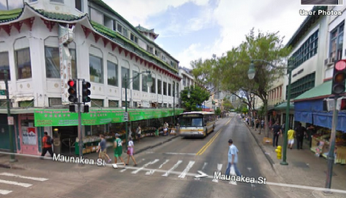
Our Independence Day post last year compared that image with what that exact location on Hotel Street actually looks like using a photo from Google’s Street View feature:
You’re invited to read that July 4th post for its observations on why the AIA’s own graphic reveals at-grade rail's major shortcomings. The stand-out observation is that the AIA air-brushed away the pedestrian crossing between the mauka and makai sides of Hotel Street – thereby disguising the danger at-grade rail poses to pedestrians.

Last July's post covered at-grade's significant negatives as revealed in the AIA graphic, including safety. All those photographs in Yes2Rail's right-hand column illustrate the safety problem, and it can’t be air-brushed away.

Saturday, June 30, 2012

Saturday Review: Sierra Club Rail Endorsement Is Step that Could Decide Issue for Many on Sideline

Sierra Club support for the rail project has been implied for months, but now it apparently will be official.
Hawaii News Now broke the story last night:

“The Sierra Club, one of the state's best known environmental groups, appears ready to back the city's $5.2 billion rail transit project in what would be a major victory for rail supporters.”

According to the TV report, the Oahu Group’s leadership voted unanimously a week ago to support the rail project. HNN quoted Robert Harris, executive director of the club’s state chapter, in saying an official announcement could be made in the coming week.

The announcement should put to rest once and for all at least one statement by four leading rail opponents in their August 2011 op-ed piece that launched their public relations campaign against rail.

Civil Beat fact-checked several major observations in the piece, including this one: “Virtually every environmental group in Hawaii opposes heavy rail.” A week after the 1500-word essay’s publication, Civil Beat’s check gave it a  FALSE . That was a reasonable conclusion given the Oahu Group’s clear statement of support for Honolulu’s fixed-guideway project.

Excellent Summary
Rail supporters appear to be as eager as opponents to leave comments below the Star-Advertiser’s stories, editorials and letters. Here’s one from today’s review of the week’s news in the Editorial section. It’s a good summary of why supporters believe Honolulu rail is needed now and for future generations, quoting:

Rail benefits everybody for the following reasons:
1) Rail provides a transportation alternative for those who cannot drive or do not wish to drive in traffic.
2) Rail provides a faster ride than buses through congested areas. Elevated rail has its own right-of-way and will not get stuck in clogged surface streets as buses.
3) Rail can carry a higher volume of people faster between any of the stops along its route.
4) When car drivers take the rail, there are less cars on the road which alleviates traffic congestion for other drivers.
5) Building the rail will create jobs and provide billions of dollars in economic activity.
6) The federal government will provide $1.5 billion of free rail subsidy which helps our economy.
We should be committed to building the rail and be confident that we can afford it. Rail is a needed infrastructure which will help alleviate our traffic problem and stimulate our economy with sorely needed jobs. Build rail now for the future. Rail projects are always opposed when planned but never regretted after they are built. GO Rail GO! Close Quote.

Opponents naturally have chimed in to ridicule the sentiment, and some presumably would argue against some or all of these six points.  As an educational primer, however, we think it works.

Friday, June 29, 2012

City Submits Request for $1.55 Billion in Federal Funds, Plus: Another Look at Yesterday’s Post

Of all the rail “milestones,” this one may be the biggest.
The City has submitted its application to the Federal Transit Administration for a Full Funding Grant Agreement to complete work on the 20-mile elevated rail line between East Kapolei and Ala Moana Center. If fully funded, the federal government will provide $1.55 billion for the project.

The Star-Advertiser’s Kevin Dayton has a comprehensive story (subscription required) in today’s paper that covers several significant pieces of news, including the FFGA application.
Michael Levine’s story in Civil Beat may be more accessible. 

The above chart is from Levine's story. Both are recommended reading for the clarity in describing the project and its financing. The Honolulu Authority for Rapid Transportation’s press release also is online.

The estimated completion date for the first phase of the project is now mid-2016. The push-back was caused largely to delays in completing the Final Environmental Impact Statement.

Also, the revised financial plan includes the FTA’s higher collection estimate for the general excise tax surcharge of 0.5 percent on Oahu transactions that is providing the local share of rail’s construction costs.

Look-Back
We called yesterday’s Yes2Rail post perhaps the most important one in this space over the past four years. It focused on the “traffic reduction” issue within the rail discussion that seems to be on the front burner this summer.

You’re encouraged to keep reading, below, if you didn’t see it yesterday.

Thursday, June 28, 2012

Understanding Honolulu Rail Project’s Big Benefit Involves Going Beyond the Opponents’ Rhetoric

Quick, answer this: Do you believe building Honolulu rail will result in less traffic congestion?
If you answer Yes, you’re correct. And if you answer No, you’re also correct. How can both answers be correct? It’s confusing, right?

Since Yes2Rail exists to provide information about the Honolulu rail project that helps educate the public, let’s take this whole issue apart, piece by piece.

First, can we all agree that Oahu’s biggest traffic problem exists on streets and highways that run east-west through the urban corridor? At least that much should be obvious; Honolulu’s worst-in-the-country traffic congestion is on those thoroughfares, so although this first point is not in doubt among most residents, it’s a key piece in understanding the traffic congestion issue.

Another point most would not disagree with is that Oahu’s population will continue to grow over the coming decades, just as it has in decades past. Another 150,000 to 200,000 people are expected to be living on the island by 2030, and the vast majority of them will be living in the long-and-lean urban corridor between town and the ewa plain.

Point three: As the population goes, so goes traffic congestion. Those additional residents will be driving vehicles, so the number of cars on the island will also increase, resulting in increased congestion.

Number four: Oahu doesn’t have space in the east-west corridor for more highways, and there’s little if any evidence that residents are enthusiastic about building them. Aside from some tweaks here and there – a new Zipper lane (created out of existing freeway space) and repainting lanes on the H-1 in town to narrow them – we have what we have. (Even if a new highway were built, it would soon be choked by congestion, but that’s a topic for another day.)

Finally, using sophisticated computer modeling that has been enhanced and improved over the years, the Honolulu rail project anticipates a daily ridership in 116,000 passengers in 2030.

Without rail, those people would be traveling on streets and highways to reach their destination along the corridor – either on TheBus or in cars and other vehicles. Another projection: There will be 40,000 fewer vehicle trips each day in 2030 than there would be if rail were not built.

Summarizing
More people driving their cars on essentially the same network of streets and highways in 2030 will produce more congestion than we have today. Congestion’s growth is inevitable, as most of us would agree.

And if we agree on the five basic points discussed above, we should be able to agree on this, too:  Without rail, there will be more congestion on Honolulu’s streets and highways than with it. Rail will reduce congestion – plain and simple. Even anti-rail leader Cliff Slater says so (see below), and since this much is obvious, the Yes answer at the top obviously is the right one.

But we also said you’d be correct if you answered No. How can that be?

It should be obvious by now that both answers are correct depending on how you view the facts.  Rail opponents are fond of saying congestion will be reduced by only 1.3 percent, a benefit too small to justify such a large expenditure. But here’s how they get to that figure:

They calculate the reduction in daily trips (due to drivers becoming rail riders in the corridor) and compare it to the total number of daily vehicle trips around the entire island. It’s a neat trick that accurately describes rail’s effect on total traffic everywhere on the island – the Windward Side, North Shore, East Honolulu, Mililani, the Waianae Coast, everywhere.

But as for describing rail’s true impact in the most congested traffic corridor in the country, it fails miserably. Rail’s actual reduction of vehicle hours of delay (VHD) in that corridor is expected to be 18 percent, not 1.3. (Note: See July 5th post for an update and clarification on the 18-percent issue.)

When you consider that VHD in the corridor is reduced by about 11 percent when the University of Hawaii is out of session, you begin to appreciate rail’s true impact on congestion. Like Mr. Slater said before the City Council, “We don’t disagree at all that rail will have an effect on reducing traffic congestion from what it might be if we did nothing at all.”

Rail's Biggest Benefit
But that’s not what you hear him and his fellow opponents say in their anti-rail campaign. They promote a misleading message that, while accurate, also obfuscates why rail is needed – because it will restore true mobility and improve travel times, not only for riders but also for drivers. We wrote about it here yesterday.

Opponents also always ignore this essential fact, which is rail’s biggest benefit: Residents who ride Honolulu’s elevated train will avoid all congestion as they travel through the east-west corridor. For them, congestion will be a big zero.

Rail will be a piece of transportation infrastructure that’s missing on Oahu today but which is found in all progressive cities around the world – a congestion-free mode of travel, either above or below street level. Decades from now, daily living on Oahu would be unimaginably difficult without elevated rail, with no alternative to massive traffic congestion that can only continue to worsen.

A final comment: Today’s Yes2Rail mini-essay may be the most important of the 772 posted here in the past four years because it cuts to the heart of the anti-rail campaign’s prominent rhetoric and exposes it for its manipulative qualities. (Visit our "aggregation site" and the section under Mr. Slater's heading for a compilation.)

Understanding the congestion issue requires more than a 30-second message on TV or radio, and we thank you for taking the time to read Yes2Rail.