Thursday, May 10, 2012

Non-Shocker of the Week: Civil Beat Finds CEO Grabauskas Tells the Truth, Plus Letter to PBN Urges Focus on Cayetano BRT, Not Rail’s ‘PR’

We’ve made a big deal of Civil Beat’s Fact Checks – e.g., the Gang of Four’s poor record on sticking to the facts – so we have to call attention to the online service’s latest investigation.
Dan Grabauskas, the new CEO of the Honolulu Authority for Rapid Transportation, has been making a strong case for Honolulu rail’s financial plan since his first day on the job a month ago. One of his more eye-popping statements to Civil Beat was that the project is like “a house with no mortgage” because all construction costs, including interest on the financing, will be paid off shortly after the entire 20-mile line is up and running.

That contrasts big time with the Massachusetts Bay Transportation Authority (MBTA) that Mr. Grabauskas used to run in Boston. “I come from an old system where 30 percent of our operating budget (in Boston) goes to debt service,” he told the City Council. “….you’ll be having an operating obligation but no debt service,” he said, because rail’s construction is being paid for by the local GET tax surcharge and a future $1.55 billion from the Federal Transit Administration.

The Truth

Civil Beat checked out the 30-percent figure, and long story short, Dan Grabauskas was telling the truth. Writes CB: “The truth is that on average over the past 20 years, 28 percent of MBTA’s operating budget went toward debt payments. That’s close enough to 30 percent for us to give him a grade of   TRUE   in his first Fact Check.”

A prediction: Everything Dan Grabauskas says about rail today, tomorrow, next month or next year will be  TRUE . That’s what he’s obligated to do – tell the truth. It’s opponents like Cliff Slater and Ben Cayetano who shy away from the facts by bending a truth – i.e., “congestion will be worse in the future with rail than it is today” – thereby turning that inevitable result of population growth into a negative for rail.

Open Letter to PBN

Dear Mark Abramson:

As Pacific Business News’ lead writer on the Honolulu rail project, you must necessarily be aware that anti-rail mayoral candidate Ben Cayetano is refusing to openly discuss his proposed rail alternative – the Harris Administration’s bus rapid transit plan that was written in 2000 and was trashed for robbing lanes from car drivers and giving them to buses. According to his interview with the Hawaii Filipino Chronicle, that's what the new/old Cayetano BRT plan will do, too.

You undoubtedly know Mr. Cayetano told Civil Beat in mid-March that he’d release details of his alleged BRT plan by mid-April. He missed that self-imposed headline without explanation, and I summarized that history in another Open Letter this week to the Honolulu Star-Advertiser’s B.J. Reyes, who also is covering the mayoral race.

The most recent piece I’ve seen that you’ve written about rail was last Friday’s story headlined: Honolulu rail supporters tell Cayetano to ‘Be Nice Ben’  It began:

“The PR campaign being waged by rail supporters and opponents of Honolulu’s $5.17 billion project has gone into a kind of ‘If you don’t have anything nice to say, don’t say anything at all’ mode.” You wrote about the tongue-in-cheek campaign launched by rail supporter Pacific Resource Partnership urging Mr. Cayetano to “be nice” after the candidate said rail supporter Senator Dan Inouye was “out of touch.”

All well and good. Everybody’s had a good laugh by now, but here’s what doesn’t get covered when you focus so much on these sideshow issues: Mr. Cayetano still refuses to release details of his BRT plan – and from my former-City Hall reporter perpective, Mark, that’s what you need to report.

Your readers need to know exactly what Mr. Cayetano proposes to do if he kills mobility-restoring, travel-time-reducing, development-guiding, transportation-equity-ensuring and job creating Honolulu rail.

Have you asked him? And if you have, Mark, what was his response? Civil Beat’s been asking and reporting that the candidate doesn’t respond to those inquiries. Did he respond to you? If so, what will Mr. Cayetano’s BRT be like? How much will it cost, where will it run, how many lanes will it steal from car drivers and where? The list of questions goes on and on. And if he refuses to respond, don’t your readers need to know that?

At the end of your story last Friday you asked: “Can an online (‘Be Nice Ben’) petition get someone to change their behavior or influence what they say? I’m guessing not.”

I’m guessing that Ben Cayetano won't volunteer details about his BRT plan throughout the remainder of this mayoral campaign unless reporters like you press the issue. That is remarkable, Mark, and in the spirit of journalism's traditional role, it would be helpful if you’d report from that perspective – one that many other reporters have used in this town over the years….just not so much lately.

Aloha,

Wednesday, May 9, 2012

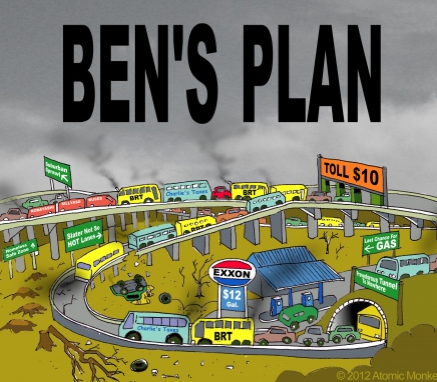
‘Mainstream’ Media Fail To Flush BRT Plan from Cayetano, so Atomic Monkey Breaks a Parody, but Wait: Candidate Reveals a Slice of His Plan -- Bus-Only Lanes on King, Beretania Streets! Auwe!!

First we simply tried blogging here, here, here, here, here, here and here about Ben Cayetano’s refusal to reveal his bus rapid transit plan. He says he’d implement BRT after he kills rail, so we naively thought the media would take the hint and start asking questions about such an ambitious suggestion.

When that didn’t work, we wrote an Open Letter to the Star-Advertiser reporter who’s covering the mayoral race and asked him to please start asking Mr. Cayetano to explain himself. That didn’t work either.

So you can imagine how thrilled we were to read Atomic Monkey’s scoop yesterday. Thanks to the Monkey (and thanks for the Monkey's permission to use its cartoons), Mr. Cayetano’s plan is revealed in all its complexity, which the story says “incorporates a half dozen ideas and technologies that have already been abandoned as obsolete, too dependent on imported oil, or just plain lolo. However, the Cayetano team insists that when all used together, they miraculously produce a superior solution."

“I always wanted to build a tunnel somewhere,” highway expert and UH Professor Panos Prevedouros told the Monkey, “so when Ben asked me what I wanted out of this, I jumped at it.”

You won’t find a better parody than Atomic Monkey’s treatment of the Cayetano Campaign’s Still-Secret Bus Rapid Transit Plan. In truth, the candidate’s failure to reveal it in full detail is no laughing matter.

Details Leak Out
Learning exactly what Mr. Cayetano has in mind after he kills mobility-restoring, travel-time-reducing, development-guiding, transportation-equity-enhancing and job-creating Honolulu rail is a deadly serious quest. Civil Beat seems to think so, too.

Writer Michael Levine reminded his readers yesterday that Mr. Cayetano “…said a detailed plan would be forthcoming in mid-April. In the weeks since that self-imposed deadline came and went, I’ve reached out to the campaign to ask for an interview to offer him a chance to share details in an op-ed and to invite him to come to Civil Beat headquarters to meet with our editors. So far, no go. But some details are slowly emerging.” 

Imagine that – a politician running away from an open invitation to provide unedited details of his campaign’s centerpiece. Any day now Star-Advertiser columnist Dave Shapiro, who devotes his space today (subscription) to yet another swipe at rail supporters, will find a way to praise Mr. Cayetano’s opaqueness on his BRT plan.

Here It Comes
Mr. Levine then quotes from a recent interview Mr. Cayetano gave to the Hawaii Filipino Chronicle. Civil Beat has a link to the entire article and quotes the most relevant paragraph on the alleged BRT plan, including this gem:

“So we’ll look at running (BRT) down King Street or Beretania Street. We may have to elevate it in certain areas but it’ll run on the freeway, so we won’t have to create a new elevated structure. When it enters Downtown, it will need a dedicated lane which may require taking away some parking here and there.”

Mr. Cayetano says the system has worked in Europe, South America and Japan, so it must be good, right? We all appreciate Honolulu’s obvious similarities with Europe, South America and Japan.

C’mon, Atomic Monkey. Now you know Mr. Cayetano is prepared to duplicate the death knell of the Harris Administration’s BRT plan – taking away car lanes and giving them to TheBus. We need a new cartoon – one with cars scrunched together as an empty bus rolls by in an empty bus lane. The Parody Potential is Positively Limitless!

Tuesday, May 8, 2012

Anti-Rail Talk Show Fritters Away Most of Hour With HART CEO, which Was Fine with the Host, Then Launches Anti-Rail Rant for Rest of Show

The anti-rail morning talk show host has complained incessantly that supporters of the Honolulu rail project have never accepted his invitation to be on his show.  It’s been one of his key talking points during innumerable hours of anti-rail rhetoric on his station going back to 2005.
So when Dan Grabauskas, chief executive officer of the Honolulu Authority for Rapid Transportation (HART) did agree to appear on his show this morning, how did the host handle the prospect of having his rhetoric refuted by a man who knows infinitely more about Honolulu rail than he does? By steering the hour away from substantive issues toward the unimportant and into cul-de-sacs of his own making, that’s how. 

What was touted in advance as an hour with Mr. Grabauskas was reduced to maybe 10 minutes of substantive rail discussion, excluding the opening biographical segment (the host’s first cul-de-sac); three calls from listeners, including one from the Big Island of all places (all three voices were recognizable from previous calls as anti-railers); traffic reports, news breaks and commercials.

In other words, the hour was perfectly directed by the host to avoid both his vulnerable rhetoric and Mr. Grabauskas’ strengths.

And what made the whole charade even more outrageous was the host’s oh-so-sincere protestations that he wants to know more about rail that he made during the hour after the interview with HART’s CEO:

 “…what is this about, and why? I’m just very curious, why? What are the justifiable reasons? It was interesting when Dan talked about traffic, about a choice, about spending time with the family, about possibly selling one of your vehicles. I get that, alright, I understand where you’re coming from…. And I’m truly interested in hearing what the explanations are and what the proposals are, what the vision is and all of that…. I know there are many other issues on the table, and we’ll get to those in subsequent conversations with Dan, about the promises of transparency…about the Alternatives Analysis process, about the federal lawsuit, why he believes rail is the solution to traffic…” yadayadayada.

What a Joke
Despite all the polite talk and kid-gloves interviewing technique, let there be no mistake about the radio host’s agenda: He wants to kill rail, and he’s not the least bit interested in transparency, even-handed discussions or anything else that might shed one ray of positive light on the project.

His open-line hour following the interview was a continuation of that agenda, inviting rail opponents to say why they’re opposed to the project. There was no similar invitation to rail supporters – just a one-way rant from the host’s true believers. On cue, anti-railer-in-chief Cliff Slater weighed in for the umpteenth time to suggest rail would be a failure because congestion will continue to increase. As the City's Wayne Yoshioka once said, "No kidding...."

Thankfully, the host's listeners make up a tiny percentage of the radio audience, and we have to admit after this morning's fiasco that maybe those who say it’s not worth spending any time talking to this particular radio station are right.

But if that time ever does come again, here’s a suggestion: Tick off the host’s objections to rail one by one, top to bottom, and expose the shallowness and misinformation on each of his points – the alternative to traffic issue, congestion reduction, noise, financing, construction byproducts, energy, ridership, TOD, jobs and all the rest.

Doing that would leave the host with no place to hide but the off switch. As for his faux desire to know more about rail, it’s a dark, black joke.

Monday, May 7, 2012

Open Letter to Newspaper Reporter B.J. Reyes: The Other News Media Follow Your Mayoral Race Stories; How 'bout Covering Cayetano BRT Plan?


Dear B.J.,

As the Star-Advertiser’s reporter covering the three-man race for Honolulu mayor, you have the hottest beat in town, and by extension, that makes you one of the most influential journalists in Honolulu.

What you report on that race to a great extent determines what the other media report. It’s been that way for decades. One-time Star-Bulletin City Hall reporter Diane Armstrong and I (for the Advertiser) took bemused umbrage years ago when our coverage routinely showed up in TV newscasts later in the day.

Now that Honolulu has only one daily newspaper, you and your colleagues at the Star-Advertiser are even more influential in setting the media agenda. That’s why I’m writing this open letter to you with a hope you’ll start reporting on what looks like the proverbial “elephant in the living room” in this race.

Doing What Comes Naturally
Mayoral candidate Ben Cayetano has said he’ll install a bus rapid transit plan if he’s elected and is successful in killing mobility-restoring, travel-time-reducing, development-guiding, transportation-equity-ensuring and job creating Honolulu rail.

He alludes to that plan without providing any details – a fairly remarkable position to take in light of the magnitude of his promise. Mr. Cayetano told Civil Beat six weeks ago he’d make those details public by mid-April, but that deadline came and went with no follow-through by the candidate.

It seems obvious by now that Mr. Cayetano is doing what a lot of politicians do when they think they’re leading a race: They duck debates and don’t allow themselves to be bogged down by inconvenient details – in Mr. Cayetano’s case, his BRT plan.

109 Days & Counting
This is where you come in, B.J. Mr.Cayetano formally announced his candidacy on January 19, so it’s past time for him to own up and say exactly how he’d address Oahu’s growing congestion problem if he kills rail. He owes us more than vague references to a 12-year-old plan that was rejected a decade ago.

If it’s the Harris Administration’s BRT plan he wants to install instead of rail, the list of questions is virtually endless – and Yes2Rail started such a list at the end of a recent post.

If you question Mr. Cayetano on the “elephant” that he so far has refused to discuss, B.J., he will either provide those details or he won’t, and you’ll be in the catbird seat – reporting on his response either way and giving the other media in town something to write and talk about, too.

Good luck in snagging the details of Mr. Cayetano’s BRT plan. We’re all counting on you.

Aloha,

Saturday, May 5, 2012

Saturday Review: Anti-Rail Candidate Attracts Scrutiny for Temper and Lack of Transparency; Cayetano’s Refusal To Discuss His BRT Plan Is His ‘Glass Chin’ or ‘Achilles Heel’ – or Both; Paper Corrects Its Report on Cayetano-Inouye Flap

It takes a five-line headline to sum up the rail-related events in the week that was, starting with a lesson for your children: Bad things can happen when you don’t talk nice.

One of those things happened this week to anti-rail mayoral candidate Ben Cayetano. BeNiceBen.com was launched in response to his unflattering comments about Senator Dan Inouye, Hawaii’s exceptionally powerful senior senator who has represented the state on Capitol Hill since 1959.

Pacific Resource Partnership, described in today’s Star-Advertiser story (subscription) as “a prominent rail supporter and advocacy group for Hawaii’s unionized carpenters and construction workers,” launched the website in response to Mr. Cayetano’s suggestion that Senator Inouye is “out of touch” and flying at 30,000 feet above local issues, like rail.

“These sorts of personal attacks have no place in our public discourse,” the website says. “When Ben Cayetano disprespects Senator Inouye – a man of integrity and honor with a distinguished record of public service – he’s disrespecting all of us.”

Fits the Pattern
In one respect, the be-nice kerfuffle works to Mr. Cayetano’s advantage by diverting attention from what the campaign’s true issue – his lack of transparency about the bus rapid transit plan he says he’ll launch when he kills mobility-enhancing, travel-time-reducing, development-guiding, transportation-equity-ensuring and job-creating Honolulu rail.

That’s a recurring subject here at Yes2Rail, but it is virtually non-existent in the news media – a journalistic lapse of unbelievable proportions months into Mr. Cayetano’s campaign that defies explanation.

Why are the news media so reluctant to ask Mr. Cayetano about the specific details of his BRT plan? Has everyone from editor to reporter gone soft? Here’s a candidate who wants to wipe away years of rail planning with simplistic concepts borrowed from rail’s chief opponent, Cliff Slater.

For example, Mr. Cayetano echoes Mr. Slater’s lack of respect for the electorate by suggesting rail will fail because congestion will continue to increase long after rail is up and running. What he won’t or can’t concede is that congestion will be worse without rail than with it. Our “aggregation site” lists numerous examples of this dumbed-down rhetoric.

Do reporters need the questions to be spelled out for them? If so, here we go: (1) “Mr. Cayetano, what exactly are the details of your BRT plan, and why are you refusing to release them as you said you would by mid-April?” (2) “Will you concede that traffic congestion would be worse without rail than with it?” And (3) “Will you concede that only grade-separated transit can provide congestion-free travel for commuters, something no bus scheme – rapid or not – can achieve?”

Ask him that and the media likely won’t hear straight answers. He’ll talk about rail’s visual impacts and sewers and potholes and a "smear campaign" as he does today and potential impacts on ancestral burial sites. (Not insignficantly, an expert in Native Hawaiian legal issues defends the city’s approach to the latter in a Star-Advertiser commentary today.)

Just Say ‘Not’
The Star-Advertiser today corrected its Friday story on the Cayetano-Inouye flap, but you need an eagle eye to find it.

Yesterday’s story said: “(Mayoral candidates) Carlisle and Caldwell both defended Inouye on Wednesday and put their full faith in his ability to get the funding. Both said they did give credence to Cayetano’s ‘hypothetical’ scenario of funds running out.”

Today’s correction at the bottom of page B-2 says the word “not” was left out of that second sentence in Friday’s edition. It should have read “did not give credence….” Talk about the impact of a three-letter word.

And if you want to see who was naughty or nice in that debate, you can watch a replay on Oceanic-Time Warner’s ‘Olelo Channel 49 at 12:30 am Monday, 9:30 am Tuesday and 1:30 pm Wednesday, and on Channel 54 at 6 pm Friday.


Friday, May 4, 2012

With Anti-Rail Columnist in Cayetano’s Corner, Media’s Role in Transit Issue Looms Even Larger; Will Rail Supporters Finally Demand ’No Mas’?

Civil Beat wrote yesterday after the first debate among the three mayoral candidates that the pattern was set in how they’d conduct themselves during the campaign. One day and one additional analysis later, there can be no doubt that the attack candidate is anti-rail Ben Cayetano.
Star-Advertiser columnist Richard Borreca, who’s also anti-rail, pounded home that message today in yet another glowing Cayetano-centric commentary that surely will be posted in the Cayetano campaign headquarters.

So far this week, Mr. Borreca has compared Mr. Cayetano to William Wallace, the battle-axe wielding hero in the “Braveheart” movie, and (indirectly) to Sugar Ray Leonard, who pounded Roberto Duran into gasping “no mas” (no more) to end their famous 1980 fight.

“’No mas’ comes to mind after witnessing the pummeling former Gov. Ben Cayetano gave former acting Mayor Kirk Caldwell in the debate Wednesday night in downtown Honolulu,” Mr Borreca writes. He says Mr. Cayetano’s tactics “were tough enough” that he had Mr. Caldwell on the ropes.

What We Need?
“So finally, we are getting it all out in the open. Cayetano’s challenge gives Honolulu the debate it needs,” the column continues near its end.

What happened Wednesday night may satisfy a columnist whose meat and potatoes is politics and campaign mayhem, but it’s not what Honolulu needs in this election.

What Oahu residents need are the details of Mr. Cayetano’s intention to substitute the Harris Administration’s bus rapid transit plan as his alternative to Honolulu rail. There’s plenty of politics as usual in this campaign; what’s missing is the most essential element that Mr. Cayetano so far refuses to discuss.

Mr. Borreca ends his column with yet another reference to boxing: 

"This week’s debate showed that before they get in the ring again with Cayetano, both Carlisle and Caldwell must figure out a way to explain why they are in the race and why their election is vital, because Cayetano certainly knows what he is doing.”

He certainly does. Throwing verbal haymakers has long been the favorite tactic of this legendary political pugilist, but Mr. Cayetano’s most obvious tactic these days is back-peddling around the ring to avoid any engagement on the specifics of his BRT plan.

Fight enthusiast Mr. Borreca alluded to that tactic by observing that neither Mayor Peter Carlisle nor Mr. Caldwell laid a glove on Mr. Cayetano: “Neither…asked Cayetano to spell out his alternatives to the rail project….”

That’s the emerging issue in this campaign. Mr. Cayetano is either holding back his alleged BRT plan for later use, or he's back-peddling because there is no suitable substitute for mobility-enhancing, travel-time-reducing, development-guiding, transportation-equity-enhancing and job-creating Honolulu rail.

The weakness of his BRT plan, which was rejected the first time around, almost certainly is Mr. Cayetano’s glass chin. One or both of his opponents eventually will start swinging away at it, and the ring-side media – who so far don't bother to report on Mr. Cayetano’s back-peddling – will have to report those blows when they land.  

It’s a one-two combination that could put the tough-talking Ben Cayetano down for the count. 

This post has been added to our "aggregation site" under the 2012 Mayoral Race & Rail heading.

Thursday, May 3, 2012

Mayoral Candidates Face Off in First Debate, but One Man’s Nakedness Goes Unreported: Cayetano Still Refuses To Provide Details of His BRT Plan

Reading the Star-Advertiser (subscription) and Civil Beat stories about last night's debate among the three mayoral candidates recalled the famous tale by Hans Christian Anderson, "The Emperor's New Clothes."
You remember it: An emperor is conned by two weavers into believing the threads of the new suit they’ve made for him are so fine that they’re invisible to the unfit, incompetent and stupid. When the emperor walks among his subjects wearing nothing but his birthday suit, a child sees the truth and blurts, “But he isn’t wearing anything at all!”

Ben Cayetano, the anti-rail candidate, is going out in public with his own set of invisible threads. He’s woven an image of a bus rapid transit plan that he’d implement instead of building Honolulu rail if he’s elected. 

Trouble is, as any child can see, there is no BRT plan – just a description as vague and invisible as the emperor’s new suit. All we know is what he told Civil Beat six weeks ago: He’d resurrect the failed Jeremy Harris BRT plan that was written in 2000. What we also know from personal contacts is that the former governor is refusing to respond to media requests for details on the recycled plan.

The BRT Fable
Using the emperor’s suit again for imagery in imagining Mr. Cayetano’s BRT plan, what size is his jacket, and where exactly will the buttons be placed? Will it have wide or narrow lapels or maybe no lapels, like a Nehru jacket? Will the vents be on the sides or at the back? Will it be fitted, European style, or cut to flatter a more portly figure? Sleeve length? Inside pockets? What exactly will it look like?

The same goes for all the missing details in the former governor’s BRT scheme. He wants to kill rail, for which construction already has begun, and replace it with an unknown, invisible and totally unvetted and untested plan that will add more buses to congestion rather than reduce it.

If political science students are looking for a naked political play to study, this surely is it – the old “duck and cover” strategy used by candidates allegedly ahead in their races to avoid being dragged down by details.

Where's the Transparency?
Mr. Cayetano is avoiding the inconvenience of discussing BRT’s specifics, and that apparently includes ducking debate opportunities that might expose his invisible BRT threads.

According to Civil Beat, “Cayetano balked at having more than 10 to 20 people in the room” when pro-rail candidate Kirk Caldwell sought his commitment to participate in “three televised, open-to-the-public debates.”

He wants only 10 to 20 people in the room and – for all we know – no TV? And he’s committed to transparency in "solving" Oahu's traffic congestion problem with buses instead of building rail? How exactly?

Rail is the biggest issue in the 2012 campaign for mayor, so it’s incumbent on the one candidate who wants to kill rail to tell the media and therefore the public exactly what he’d do instead.

This is where the journalists in town need to step up to their responsibilities as the inquisitors for the public. How much longer are they going to wait for Mr. Cayetano to produce his invisible BRT plan?

The time for politely asking for those details has long since passed. It’s time to “demand” them, and if the candidate ignores those urgent requests, that needs to be reported, too.

Cliff Slater and other anti-rail “weavers” have created this problem for Mr. Cayetano. They’ve dressed him up in a bus-based plan that can’t possibly duplicate the contributions of mobility-enhancing, travel-time-reducing, development-guiding, transportation-equity-ensuring and job creating Honolulu rail.

Talk about naked.

This post has been added to our "aggregation site" under the 2012 Mayoral Race & Rail heading.

Wednesday, May 2, 2012

Community Turns Out for Informational Meeting; Unlikely Pairing -- Honolulu Rail & Cans of Soup, Plus: Some Questions for Candidate Cayetano

 McKinley's cafeteria was filled for the rail outreach meeting.
The first in a series of Community Information Meetings enjoyed a big turnout last evening at McKinley High School’s cafeteria. The series continues this evening at Radford per the rail meeting schedule.
 
The Rev. Bob Nakata (left) of Faith Action for Community Equity (FACE) reminded attendees before the session actually kicked off that his organization believes rail may be the last chance for Oahu to create affordable housing for this and future generations. With high rankings in electricity rates, gas prices, groceries, real estate and other indices that make up the cost of living, living on Oahu is bound to be even more expensive in years ahead. Reverend Nakata said transit-oriented development will be a key feature of the rail project, and he urged attendees to make that point whenever and wherever they can.

Once the meeting actually began, new HART CEO Dan Grabauskas (enjoying a quick bite at right) provided an overview of the project and answered questions from the floor before break-out groups delved into transit-oriented development, rail operations and other topics. The former head of the Boston transit system told the audience the elevated rail plan that’s being implemented – construction on the support columns began last week – was selected after numerous alternatives were studied years ago. Elevated rail is the only way for commuters in the east-west corridor to completely avoid traffic congestion.

No Soup for You?
One question from the floor had a familiar ring to it, since it riffed off rail opponent Cliff Slater’s stump speech. “I’ve read that traffic congestion in the future with rail will be worse than it is today,” the Makakilo resident said. “What’s the truth in that?”

The answer, of course, is that congestion would be worse without rail than with it, something Mr. Slater even had to admit before the City Council a couple summers ago. Later, in discussion, the questioner revealed the mindset that drives many who find a reason to oppose rail.

What he and they want is an absolute “solution” to traffic. He said if he’s hungry and goes to the store for a can of soup, he knows the soup can will “solve” his hunger problem. Rail shouldn’t be any different, he reasons; he believes an investment of several billion dollars should be able to wipe away traffic, just as a can of soup wipes away his hunger.

It’s an inventive way to find fault with rail, but our conversation reminded us that leading a horse to water won’t necessarily result in drinking. When someone is dead set against the project, there’s little likelihood “truth-telling” will get through – even the obvious truth that Oahu’s population will continue to grow and so will the number of vehicles, all resulting in more traffic congestion than we have today. Rail and nothing else will "solve" congestion.

With little enthusiasm on Oahu – let alone the space – for building more highways here, rail will allow users avoid the inevitable growth in congestion. But equating congestion with hunger and thirst may not be so off the mark after all. Sooner or later, we simply must eat and drink to overcome both – either that or die.  Traffic congestion already has reached unacceptable levels for commuters, and a daily diet of riding Honolulu’s future train will help them cope with it by avoiding it.

Questions for Ben
Anti-rail mayoral candidate Ben Cayetano will hold another of his chilli-and-rice dinners this week. It’s billed as an “ask the candidate” event, so here are the top three questions that need asking:

1. “You say rail won’t solve the traffic problem, but isn’t it true congestion would be worse without rail than with it?”
Answer: If he’s truthful, Mr. Cayetano will have to answer in the affirmative. He’s taking his cues from Mr. Slater (see above), and in so doing, there’s no other way to answer it truthfully.

2. “Isn’t it true that the bus rapid transit plan that you’re borrowing from the Harris Administration wouldn’t end the congestion problem?”
Answer: If he’s truthful, Mr. Cayetano will have to admit that. Adding more buses to already congested roads and highways can’t possibly reduce the inevitable growth in congestion.

3. “When will you do the right thing and publicize the details of the BRT plan you want to implement if you’re elected after you’ve killed mobility-enhancing, travel-time-reducing, development-guiding, transportation-equity-enhancing and job-creating Honolulu rail?”

We don’t know the answer to that one. Only Mr. Cayetano knows. He formally announced his candidacy 104 days ago on January 19. There are only 101 days to go before the primary election, which means Mr. Cayetano has managed to stall for more than half the time between announcement and election.

Of course, his supporters don’t care about his BRT plan, since most are really concerned only about killing rail. He represents their best chance to achieve that goal, but what about the media? Do reporters care?

We heard from one reporter who’s closely following rail that he’s been asking Mr. Cayetano for the BRT plan's details, and the candidate is refusing to respond to his inquiries. Is that the brand of transparency Mr. Cayetano is proposing in his administration?

That qualifies as another question, so we’re obligated to provide the Answer: Only if the media and public let him get away with it.

Tuesday, May 1, 2012

New Transit Chief Meets Public Starting Tonight, Lays Out Rail Rationale on Perry & Price Show: Commuters ‘Are Going To Use It and Love It’

Mr. Dan Grabauskas, the new chief executive officer of the Honolulu Authority for Rapid Transportation, has been on the job three weeks and is wasting no time living his message of project transparency.

Mr. Grabauskas will be the principal speaker at tonight’s Informational Community Meeting from 6 to 8 o’clock in the McKinley High School cafeteria. Other evening sessions will be held over the next week in and near communities whose residents will be served by the rail project.

He’s also talking with the news media, including the top-rated Perry and Price Show on KSSK this morning. Here’s a partial transcript:
Grabauskas: You pretty well see that the road system is broken. (After) having added more lanes and focused on the Zipper lane, we’ve just reached a point of capacity or incapacity on those roadways, and there’s not a lot of room left. What we try to do is look at all alternatives, and there have been a number of alternatives looked at. I’m excited, and I’m here because I feel the rail alternative that’s been voted on and decided is a really positive thing to do. My experience throughout the country is such that when you get this kind of density and this kind of traffic – and frankly, maybe uniquely here, the price of gas – you really see that it’s an absolute waste of time and money sitting in traffic, and rail can be a solution to that.
Larry Price: We pretty much go along with the idea. It seems like everybody is pulling for it and everybody wants it, and now, the City Council is coming up with a bill that’s going to give you 450 million dollars in low-interest loans for unforeseen problems that occur. Is that typical?
Grabauskas: As people may know, the rail project construction is funded by the half-a-percent (increase) of the (General Excise Tax), and the Hawaii congressional delegation will get another one point five five billion dollars from the federal government. The money being debated right now in front of the City Council is a requirement by the Federal Transit Administration that all new projects identify a contingency in the event of some unforeseen circumstances so that you are able to complete the project after having invested locally and federally these billions of dollars. The money that’s being tapped is described in front of the Council literally as money we hope we’ll never use. It’s only for unforeseen circumstances.
Mike Perry: I think a lot of people are still under the misconception that when we get rail, traffic will be better than it is now. Traffic will never be better than it is right now. It will be – with rail – less worse. Is that a reasonable way to state it?
Grabauskas: What we’re hoping to do is to see anywhere between a 15- and 20-percent decrease in the traffic on the roads, so you’re still going to have a very challenging system, which would certainly be true if you tried to add buses into traffic. The real goal with the rail is to have an opportunity to have (transit-oriented development) concentrations along the rail corridor where more people can (live and) ride rail and get to and from their jobs (instead of) having to get on the H-1 in traffic.
Perry: And can we afford to maintain this rail? Will this be something going forward that will not bankrupt the City and County?
Grabauskas: Absolutely. I come from Boston, where we had the oldest rail system in the United States chugging along for 114 years at this point, and it has been only a boon to the city. The city of Boston and other cities around the country and world, when they reach the level of density that we have here, with as many people crowded into a very narrow corridor, it’s a real plus. I don’t think you can afford not to (build rail), given what the traffic is, and we’ll all have to be creative (with) even further solutions in the future if we’re going to have sustainable development.
Price: So when are you going to take on some of these people who are adamant about not having the rail system, like the (former) governor and people on the windward side? Are you going to go out to the public and actually show them the X’s and O’s?
Grabauskas: Absolutely right, and in fact, we’re starting tonight at McKinley High School cafeteria from 6 to 8. We’ll be having an informational community meeting, and then we’ve got one on Wednesday evening at Radford High School cafeteria in Salt Lake, and on Thursday from 6 to 8 at Farrington High School cafeteria in Kalihi, and two more next week. If people are interested in any information about those meetings, they can call 768-6159, or better, just go to HonoluluTransit.org.
Perry: This is a confusing thing for the people of Hawaii. We’re still pretty agnostic about the whole thing because we don’t know. Does anybody know, going forward, how a rail system will work? Some are total disasters, there are some that work, and really, we don’t know. You are saying that you have pretty good confidence in fact that this one is going to be all right.
Grabauskas: From everything I’ve seen about this project, I see it as a real big plus. It’s going to give relief to people in West Oahu, the relief that’s been promised to them for a long time. I’m looking at this as a way to relieve the most unproductive time that I see being spent anywhere on the island, and that is traffic every morning and traffic every afternoon and traffic in the middle of the day now. So if we can do something to give people a reliable 40-minute ride from Kapolei to downtown, I think they’re going to use it and I think they’re going to love it.
Perry: Dan, I have a feeling we’ll be talking to you a lot in the next several years.
Grabauskas: I look forward to it. Thanks very much, Mike and Larry. I appreciate it. Happy May Day and Lei Day.

Yes2Rail: Our sentiments exactly!

Monday, April 30, 2012

If Transparency Is the Goal (and It Is), It Must Be Applied to Everyone & Everybody in Rail Debate; That Includes Candidate Who Vows to Kill Project


“Regardless of where people stand on Honolulu’s rail transit project, it is clear that the community benefits from more transparency and more discussion about how taxpayer money is being spent on a project that will have a significant impact on the future of Oahu and our state.”

That’s the opening paragraph of an op-ed piece in today’s Honolulu Star-Advertiser (subscription required) by the co-chairs of Move Oahu Forward, a new group formed to support the Honolulu rail project.

Transparency is what HART’s new chief executive officer Dan Grabauskas says will define the project under his leadership. People all over town – City Council members, rail opponents, project supporters, the media – are embracing the commitment to transparency in and around the largest construction project in the state's history.

But not everyone shares that commitment. The one person who holds more individual power over rail’s future than nearly anyone else is following the anti-transparency playbook. Mayoral Candidate Ben Cayetano, whose campaign is driven by his opposition to rail, has turned his back on transparency and everyone who believes in it.

Missed Deadline
Mr. Cayetano announced his candidacy on January 19 and his intention to terminate the rail project if elected saying, “There’s no sense in criticizing if you don’t come up with some kind of solution.” Since then, he’s been campaigning against rail while avoiding any details about his alleged solution.

What he has offered is the headline of a solution and nothing else – Cayetano’s Transit Plan Mirrors Harris’ in 2000. Civil Beat used that headline for a March 21 piece that included this: “Cayetano told Civil Beat Editor and General Manager John Temple in an email that he would share the full transit plan by mid-April.”

We noted two days ago that Mr. Cayetano had failed “The 100 Day Test” – a standard measurement for the accomplishments of office-holders, beginning with Franklin Roosevelt in 1933 and continuing to this day. We suggested then that the candidate who would kill the rail project and everything it represents should have met that test, but didn’t.

Politics as Usual
What’s there to make of Mr. Cayetano’s non-commitment to transparency? It seems obvious. He’s employing a favorite strategy of political candidates who think they’re leading in their race: Don’t let yourself be pinned down on specifics.

The leading candidate willingly risks the opponent’s outrage and media criticism that he or she is ducking debates and plows ahead with campaign messages that seem to be working.

By confining his statements to rail’s cost and aesthetics, Mr. Cayetano avoids the potentially disastrous prospect of defending the Harris Administration’s bus rapid transit plan, which was attacked from nearly every side and died.

Mr. Cayetano wants to kill rail without telling the public any details about his BRT replacement – precisely because BRT is woefully inadequate in matching mobility-enhancing, travel-time-reducing, development-guiding, transportation-equity-ensuring and job-creating Honolulu rail.

We shouldn’t expect the anti-rail candidate to volunteer answers to any of the questions we included in our “First 100 Days” post two days ago. But the public deserves to have those and many more questions answered about the Cayetano/Harris BRT plan.
 
Mr. Cayetano has been silent for 102 days since his announcement, with 103 days remaining before the primary election on August 11. If his strategy has been to wait until the second half of his campaign, that half begins tomorrow. A commitment to transparency by the candidate who would kill rail is way overdue.

Saturday, April 28, 2012

‘The First 100 Days’ – a Standard Good for US Presidents, Governors and Mayors; Time’s Up for the Candidate Who Vows To Kill Honolulu Rail

Today is the 100th day since Ben Cayetano formally announced his candidacy for mayor with one primary promise -- to kill Honolulu rail if elected.  

To give that promise some needed perspective, here’s what he wants to terminate – a mobility-enhancing, travel-time-reducing, development-guiding, transportation-equity-ensuring and job-creating project that will provide congestion-free travel through the city.  
 
Our own proposition is simple: If that’s what the former governor wants to terminate, he must describe in detail what he would install in rail’s place as a workable response to traffic congestion that’s become nearly intolerable for thousands of highway commuters.  After all, grade-separated transit -- the only possible mode to achieve fast, frequent, reliable and safe travel – has been in hot, then cold, now hot again development for at least two decades. You don’t just blow up all that effort without a plan.  
 
If candidate Cayetano had been well-prepared and strategically-focused, he might have descried his plan on January 19 when he announced, 14 weeks and two days ago. “There’s no sense in criticizing if you don’t come up with some kind of solution,” he told reporters gathered for his campaign launch.

Mid-April Gone
But he didn't articulate his "solution" then,and for all we know, he doesn't have it 100 days into his candidacy. Most of what we do know about what Mr. Cayetano intends to build instead of rail was briefly mentioned in his March 13 press conference: 


"We're working on a plan, and I've been asked for that plan by some people, including a blogger who's here today." (Yes2Rail was there.) "The specifics are in the Bus Rapid Transit plan compiled in 2000 by the same company that's advising the city now in the rail project -- Parsons Brinckerhoff. They compared all the alternatives and found that BRT would cost a fraction of what rail would cost."

Mr. Cayetano did not provide any details on his plan that day. His next comments that we're aware of were in an email he sent to Civil Beat, the online investigative news source. Here's what Civil Beat wrote on March 21: "Cayetano told Civil Beat Editor and General Manager John Temple in an email that he would share the full transit plan by mid-April."

If mid-April was his target, Mr. Cayetano has slipped it by two weeks. Today is indisputably late April -- so late that May is only three days away. 
Duck and Cover
Mr. Cayetano isn't the first candidate who adopted the silent strategy after a public opinion survey "snapshot in time" found him or her leading a political race. We're only speculating here, but that's our guess on what's going on: Mr. Cayetano and his advisers believe the less said about transportation during this campaign, the better -- an incredible position if true since his campaign is propped up by an anti-transit plank.

That strategy is appropriate since the campaign surely realizes Mr. Cayetano's BRT plan -- a recycled Harris Administration plan written a dozen years ago -- can't withstand the aggressive challenges that will surely come from rail proponents and maybe even the news media. It's the "Duck and Cover" strategy -- what school children did in nuclear war drills in the 1950s. It wouldn't have worked in a nuclear attack then, and we don't think it can work in 2012.
 
At some point, the public and its presumed media watchdogs will start asking for details on exactly how BRT would work, where it would operate, which highways it would use, how many car lanes would be reserved exclusively for bus use, how much it would cost to ride and operate, how big its taxpayer subsidy would be, how much congestion would grow by adding more buses to traffic, which communities would be served and which would be bypassed, what the BRT travel times would be and the comparisons with rail and highway travel times, how travel reliability could be assured by using buses that inevitably would be delayed by traffic along their routes, what BRT's accident probabilities are, whether BRT could foster affordable housing development as rail will, what about energy use and pollution creation and about a hundred more questions.
 
Honolulu's primary election is 15 weeks from today. Mr. Cayetano failed "The First 100 Days" test. He has just 105 more in which to explain away the years of detailed planning that have gone into Honolulu rail.

Friday, April 27, 2012

Media Panels on Honolulu Rail Coverage Note Challenges Supporters Face in Making Their Case

 Is the rail project too big for media to get their arms around?
ThinkTech’s monthly luncheon yesterday was billed as “an in-depth conversation with a host of journalists” on media coverage of Honolulu rail, the largest construction project in Hawaii history.

What we think we heard was a thoughtful recognition among most of the current and former journalists on two panels that rail is almost too big to cover adequately. They try, but their apparently sober self-appraisal was that rail is so huge and important that it may be just too big to get their arms around – at least on a consistent basis.

Media coverage itself has become an issue (see our concerns about recent media-sponsored rail polls), and that’s why we’re devoting so much space to yesterday’s panel discussion.

The luncheon’s first panel included Hawaii News Now news director and former Advertiser editor Mark Platte, former TV journalist Barbara Tanabe, former Advertiser editorial writer and political reporter Jerry Burris and former New York Times writer and current contributor Richard Halloran. A second panel began with Michael Levine of Civil Beat, Malia Zimmerman of HawaiiReporter.com and Mark Abramson of Pacific Business News. We ran out of time couldn’t stay for blogger Ian Lind’s and UH professor emeritus Neal Milner’s presentations. All remarks below are condensed from their presentations and a Q&A follow-up. We’ve quoted extensively and paraphrased closely on occasion based on the recording we made.

Fair or Slanted?
Before the panel discussion began, moderator Steve Petranik of Hawaii Business Magazine asked audience members whether they felt media coverage had been slanted or fair. The hands-up poll showed a fairly even split.

Petranik later asked whether those who felt coverage has been slanted believe the slant agreed with their views on rail – i.e., whether rail supporters saw a pro-rail slant and rail opponents perceived a slant that reflected their views. Almost no hands were raised, leading Burris to say news consumers’ perception of rail coverage is a reflection of their own biases.

Rail – a Big Deal
Barbara Tanabe: The Honolulu rail project is a “great big deal” that affects us all. The city will spend more than $5.2 billion, so by its sheer size, it deserves priority attention and coverage by the news media in the state.  The city, to fill a requirement to receive federal funds, must keep the public informed about the project. It’s called public engagement, so the city has set up (outreach) as a requirement to receive federal funds…. The bottom line is: As members of the public, are we better informed because of the city’s extensive public engagement process?

I think public awareness is high because of the public relations effort, but public understanding comes through a deeper dialogue, and that’s why the news media are so important. They must have access to city officials running the rail project, and they should have access to documents from which decisions are made. News is not just what people are talking about today. News is what people should be talking about, most of all, the reporters to raise the questions based on what’s in those reports and studies that most people generally don’t have access to or wouldn’t read anyway.

Limited Resources
Mark Platte: I don’t think there’s a bigger project or a bigger issue that we can cover than rail. It is a legal story, land development story, political story, a social story – you name it, there’s contracts, money, influence, everything you could possibly imagine… I’d love to be able to put a team together to cover rail, but the resources just aren’t there. We will continue to do our best on all the aspects of rail that need coverage.

I don’t think the general person out there really has a full grasp of this project. I think it’s still something that’s out in the future. The enormity of it is probably too much for most people to grasp, but now, with construction beginning with more coverage being focused on that, I think you’re starting to see a lot more interest, with people saying, well, now it’s a reality. Do I like it? Do I not like it? It’s here. It’s a real thing, and that’s why you’re seeing coverage that’s almost every day because of the construction, because of the litigation. You’re going to see pretty much from now on daily coverage…

Politics-Driven
Jerry Burris: There are two ways to look at rail and its coverage. On the one hand, the project is engineer-driven, by costs, routing, etc., but in truth, it’s really driven by politics. The story in terms of the media is basically a political story. New mayors get infected with the desire to have a railroad. This has been going on forever and ever….

The coverage in totality has been fair and even-handed. The problem with rail coverage is the same problem you have with politics. There are many points of entry if you’re opposed to rail – for aesthetic reasons, for the cost being too high; you want the money spent elsewhere. You’re opposed to it because you live in Hawaii Kai or Windward Oahu and you don’t see any reason that you should pay taxes for something that you don’t think you’ll benefit from. So there are all these points of entry if you oppose rail, and there are all sorts of reasons to be opposed to the rail coverage if you feel that way.

Meanwhile, those in favor of rail have only one big argument: We’re congested and we need to do something about it or we’re gonna be in gridlock in the years to come. And that’s a good argument and it really rings true for those poor people stuck in Kapolei. You have to bring that (truth) to people who aren’t facing that congestion every day. If you step back and look at it, coverage of rail over the past 20, 30, 40 years has been reflective of a larger context and conversation in the community. Lots of people are opposed for their own individual reasons. Mayors and those who believe in rail are supportive of it, and you see what’s reflected in your own mirror, and I think that’s been the case in people’s attitudes about the coverage of rail.

‘Outsider’ View
Richard Halloran: He looks at rail as an “outsider” and hasn’t written anything about rail and can’t imagine doing so. He believes there are four kinds of readers on rail – the few people in Hawaii “who don’t give a damn,” the casual readers who pay attention to the tipping points, the people who are intensely interested because they may use rail because of where they live and work and the parties to the current rail dispute. There are many people involved in this problem, and many will read media stories with a dictionary in one hand and a microscope in the other, and those who report on rail can expect to be recipients of the “Chinese torture of a thousand cuts” before it’s all over. Finally, he said advertisers in a community this small can have much more influence on what’s covered than what they’d have in a larger city.

The Bigger Story
Michael Levine: I think we’ve lost the forest or the trees…in missing the big impact of the project and getting hooked on the particulars of the project. Jobs, cost and traffic congestion are among them. There’s been a lot of discussion about whether or not rail will help (with congestion). I think it’s pretty clear that traffic in 2030 with rail is going to be worse than it is today…. I actually think that all three of those – the cost, the jobs and the traffic – are red herrings from what the big issues really are. One of the long-term goals is to change people’s behavior (an opponent calls it “social engineering”), and that means getting people out of their cars. That means increasing density on the leeward coast. It means, according to Dan Inouye, removing the (traffic congestion) barrier for people who live out that way from opportunities in town. I think that gets glossed over because it’s hard to explain and hard to understand.

And for the people who are pushing rail, it’s hard to sell. It’s hard to tell somebody they should invest this time, this money and this energy now for something that’s going to benefit their grandkids in 2050. I think that transit-oriented development should really be more of this story. It’s something I should focus on more. I try to, but there are some challenges to it if you’re trying to figure out who’s gonna get rich from rail, which is something we always try to do with our coverage…. It’s a good thought exercise to try to envision what the place is gonna look like, who’s going to benefit and how does rail fit into the future and shape the future of Honolulu beyond the political realities….

There is the lawsuit, there is the mayoral election and there is the federal funding, and they’re all hanging in the balance. They’re going to be decided soon, and that’s going to make or break the project, so you’re going to see a lot of daily coverage from myself and everybody else for now. And it’s gonna be hard to talk about the vision for 2050 when you’re not even sure the project’s gonna survive until 2013. That’s the reality right now, but I think when we’re talking about how the media cover rail you have to acknowledge that beyond the horse race, beyond the daily story there is a big big story underneath the surface. It’s lurking right there, and some people have touched on it a little bit. I hope the media, myself included, focus more on that. There needs to be more coverage of how this is gonna change the future of Honolulu….

Conclusion
The two-hour session was a refreshing confirmation for those of us believe mobility-enhancing, travel-time-reducing, development-guiding, transportation-equity-ensuring and job-creating Honolulu rail project deserves more and deeper coverage than what it's receiving from the Honolulu news media. 

This post has been added to our "aggregation site" under the Project's Goals, and more heading.