Friday, May 18, 2012

A Conversation with TV Stations' Rail Journalist: Tim Sakahara Calls to Inquire about the Rail PR ‘Sideshow’ but Ignores Elephant in the ‘Big Top’

Hawaii News Now's Sakahara begins report on "PR Nightmare."
Yesterday’s email and phone call were from Tim Sakahara of Hawaii News Now. That itself was unusual, since our work on the Honolulu rail project doesn’t include media relations.
Mr. Sakahara wanted to talk about the project’s public relations activities, since he’d been put onto that story by at least one office holder who has asked about alleged PR “redundancies.” We told him we know nothing about HART’s PR issues, if any exist.

He then asked about our own connections to the project as a “paid consultant,” a fact displayed prominently at the top of this blog. We explained our subcontractor relationship with PB Americas, the city’s principal rail contractor, then shared a few thoughts (paraphrased as follows) with this highly visible TV journalist who covers Honolulu rail for three Honolulu stations. (Mainland readers might be astounded to learn that.)

“Tim, if I may, all this interest in the rail project’s so-called public relations effort is hard to understand. Communications outreach is necessary in every major transportation project funded by the FTA, so having personnel doing that work is neither surprising nor particularly noteworthy. It seems to me you’re so consumed by the PR Sideshow that you’re missing the elephant of a news story in the Big Top – Ben Cayetano’s still-secret bus rapid transit plan.”

Mr. Sakahara’s response was non-committal at best. He didn’t evidence any agreement with our assessment, but we thought we detected a glimmer of recognition that such a story may indeed be inside the Big Top.

‘Rail’s PR Nightmare’
We waited for the 6 o’clock news last night with more anticipation than usual. Mr. Sakahara introduced his report with a remarkable graphic displayed next to him, as seen in the photo at the top of today’s post.

“PR Nightmare”? Is that Mr. Sakahara’s opinion? Is it the newscast producer’s assessment or the news director’s? Who at HNN will claim ownership of this obvious editorial comment in the middle of a newscast? The news story itself hadn’t even begun, and already PR is being trashed as a “nightmare.”

Mr. Sakahara’s piece began: “At prior rail events, there have been more public relations people than reporters.”

What is Mr. Sakahara’s point 13 words into the story – that too many staff people work at these events where the public is informed about rail?  Does he know those public relations people are there to answer the public’s questions about rail – answers they apparently can’t get in media coverage?  What’s surprising to us at these meetings is how few reporters bother to attend.

Mr. Sakahara counted up the number of communications people working for HART, key HART consultant InfraConsult and building contractor Kiewit Pacific. Then there are subcontractors,” Mr. Sakahara continued, “like the Yes2Rail blog written by Doug Carlson. He is a communications specialist paid (emphasis in the reporter’s voice-over) by Parsons Brinckerhoff to write the biased blog to advance rail.”

“Biased blog.” We’d choose any number of other words to describe this space, but that one is loaded and may say more about Mr.Sakahara’s approach to covering rail than anything we can write here.

‘Channel’ Journalism
Mr. Sakahara has shown a tendency to run with certain office holders’ criticism of the rail project and its staff, including last night’s report of the project’s communications efforts. 

Last July, less than two weeks after HART’s official stand-up, he reported on concerns in some City Hall offices that HART staff was leasing office space in downtown Honolulu. The fact that those same personnel had been in that same space for four years as employees of the City’s Rapid Transit Division was downplayed and virtually overlooked.

There’s nothing new in newsmakers seeking out friendly reporters who turn criticisms into prominent stories. The practice is as old as journalism itself, but what’s missing in Honolulu media coverage of rail is a sense of balance.

Inside the ‘Big Top’
The biggest rail-related story pregnant with potential today is what mayoral candidate Ben Cayetano would try to implement if he wins the election and kills rail. Yet that’s the story most local journalists are not reporting. They are not asking for Mr. Cayetao's bus rapid transit plan and don’t  report Mr. Cayetano’s refusal to release it.

Civil Beat’s rail reporter says he’s been asking Mr. Cayetano for the plan’s details, and the candidate is not returning his calls – perhaps a lingering hangover from February when Mr. Cayetano banished that reporter.

This “biased” Yes2Rail blog is apolitical and posts commentary on Mr. Cayetano and his anti-rail, pro-BRT efforts because they threaten a project that was planned over several years and endorsed one way or another in numerous elections by Oahu residents. That all happened before Mr. Cayetano and his Gang of Four launched their own anti-rail public relations campaign last August with their 1500-word manifesto in the Star-Advertiser – a piece Civil Beat’s Fact Check feature took apart.

Rail project communicators are charged with educating the public, and that often includes highlighting the misinformation and inaccuracies of rail opponents. Mr. Sakahara calls this blog and presumably other communications efforts “biased,” but would he use this same loaded word to describe the opinions of prominent rail opponents and critics?

We don’t think he would, since the thrust of his own rail focus parallels their attitudes. So consider today’s Yes2Rail post an Open Letter to Mr. Sakahara urging him to broaden that focus. We’ve already posted similar epistles to the Star-Advertiser’s B.J. Reyes and Pacific Business News’ Mark Abramson urging them to enter the Big Top and start describing the elephant in there.

Failing that, they risk wearing the “biased” tag themselves.

Meanwhile
Elsewhere in rail-related news, the project generated these headlines in today’s Star-Advertiser (subscription):
Most claims over railproject’s impact on sites are dismissed

The beat goes on.

Wednesday, May 16, 2012

STOP THE PRESSES: Details of Cayetano BRT Plan Leak in Radio Show; Oahu Can Anticipate Buses Running in Highways’ Shoulder Lanes!

Mayoral candidate Ben Cayetano officially entered the race 17 weeks ago tomorrow with a pledge that he will kill the Honolulu rail transit project if he’s elected.
That's nearly 120 days during which Mr. Cayetano could have openly discussed the details of the bus rapid transit plan he wants to implement instead of rail. It's logical he'd have such a plan ready for independent analysis by the media, transportation experts and voters, right?

It would be logical but not good politics, as the savvy former governor and his insiders know. Allegedly leading this race according to some but not all public opinion surveys, Mr. Cayetano is limiting his exposure in the media and reducing opportunities for his opponents to debate him.

University of Hawaii Professor Panos Prevedouros, whose anti-rail mayoral campaigns in 2008 and 2010 were remarkably unsuccessful, was the morning anti-rail talk show host’s guest today and took questions that ranged from Greece’s fiscal problems to transit oriented development. One caller wanted to know about Mr. Cayetano’s still-secret BRT “solution.”

'What's the Frequency,' Panos?
Caller “Keith”: Ben Cayetano has mentioned that he’s working on a plan that’s based on the old Jeremy Harris BRT plan, and he mentioned Dr. Prevedouros as one of the people he’s working with. He went on to tell…John Temple of Civil Beat that it would be unveiled April 15. That was 30 days ago. What can Panos tell us about the plan?
Hamada: All right, good question. Thank you, Keith, for the call. 
Prevedouros: I don’t know, Keith. I guess you didn’t have a chance to go to one of the, one of the…what is it called?
Hamada: Chili and rice?
Prevedouros: Chili and rice and discussion-kind of forum. The governor has had three of them where the transportation plan actually is presented. He hasn’t put as much on the website, but you know, he doesn’t have a sewer plan on the website, and he doesn’t have a water main plan on the website, so he is out there and he’s talking about it.
(Yes2Rail: Dr. Prevedouros acknowledges that the candidate has yet to post the BRT plan at the campaign website, and the justification apparently is that he’s not posting ANY details about what he’d do to “fix” Oahu. Could Mr. Cayetano’s campaign be any less transparent?)
Prevedouros: As you said, you are correct that, you know, part of his plan is to beef up the number-one bus transit system in the United States instead of trying to cut its schedules and make it, you know, one of the worst by taking away its money and restructuring the routes, etc., etc. I think (unintelligible) is building for something that we are number one in the nation, and that’s the best strategy we could possibly have.
(Yes2Rail: Dr. Prevedouros’ sweeping generalization contains no details, no specifics and nothing of substance – so far.)
Hamada: Speaking directly about Mayor Harris’ BRT plan that eventually was scrapped, are there benefits to that particular plan, and is there a move afoot to really take some of the details that previously had been proposed and implement them, Panos?
Prevedouros: Definitely, with a lot of additions. One of the problems, the early problems of that plan was that there was some discomfort on the part of the State DOT for the use of ramps or special ramps on the freeway, etc. But the revised plan essentially uses something that is used extensively in a few other places in the United States and worldwide, which is called BOS – bus on shoulder. So in addition to the Zipper lane, and now we’re gonna have also a P.M. Zipper lane which did not even exist in the time of Mayor Harris, we have ways to really provide meaningful and, uh, bus service from multiple areas, particularly areas that are facing severe congestion such as any area between Mililani and Kapolei.

BOS is BRT?
Buses operating on the freeway’s shoulder is one more detail of Mr. Cayetano’s BRT plan we didn’t know prior to this radio interview, making a total three details: (#2) Some of the BRT system would be elevated (we know not where), and (#3) some parking space on Beretania and King streets (and presumably some traffic lanes, too) will be needed for BRT (see yesterday’s Yes2Rail post on Mr. Cayetano’s Hawaii Filipino Chronicle interview). And that’s all, folks.

Envision this – buses speeding along in the shoulder lane next to cars creeping along in H-1 congestion in the slow lane. How does that look to you? It looks impossible and dramatically unsafe to us. No traffic engineer with a shred of common sense could endorse a plan calling for buses traveling 55 mph three feet or less from cars moving at 5 mph.

Not that they’d ever get up to 55 mph or, if they could, stay there for long. Shoulder lanes exist as safety margins and space for vehicles that have broken down. Mr. Cayetano apparently has adopted a plan that would turn the shoulder over to buses. So BOS isn't really rapid, is it? Let the questioning begin.

Callers like Keith wonder about Mr. Cayetano’s missing BRT plan deadline and ask questions the Honolulu news media should be asking, a point we’ve beaten to death over the past month, including yesterday. With schemes like BOS and LTA (Lane Take-Away), it’s obvious why the candidate is reluctant to expose his plan’s details, such as they are.

Less obvious are the media’s reasons for not demanding to know them.

This post has been added to our "aggregation site" under the 2012 Mayoral Race & Rail heading.

Tuesday, May 15, 2012

Star-Advertiser Said Cayetano’s ‘Email-Gate’ Was ‘Disservice’ to Public, So What Does Paper Say About His Refusal to Release His BRT ‘Plan’?


Remember this? It’s from a March 18 editorial in the Sunday Star-Advertiser:
“For all his professed concern for the taxpayer in his fight against the planned rail system, former Gov. Ben Cayetano is not serving the public interest with his latest tactic of cherry-picking through old communications in his effort to turn public opinion against the project – and to boost his own candidacy for mayor.”

That lead paragraph in the editorial (subscription) produced a torrent of “telling the truth is no disservice” letters to the editor from the Cayetano faithful, for whom the editorial’s intent was lost.

Those old emails were a sideshow that proved nothing and added less to the pubic discourse on rail. As the editorial went on to note: “We expect better from the distinguished former governor of Hawaii.”

The newspaper’s editorial staff can expect all it wants, but it’s still not getting it – not if the man who would kill the mobility-restoring, travel-time-reducing, development-guiding, transportation-equity-ensuring and job-creating Honolulu rail project refuses to provide any details about his intended substitute, a bus rapid transit system.

Not just any BRT system. This is the Harris Administration’s plan, which was written a dozen years ago and thoroughly trashed before being dumped as unacceptable for any number of reasons, including the necessity to “Rob Peter to Pay Paul” – take street lanes from car use and dedicate them to BRT buses.

Silence Isn’t Golden
All we know about Mr. Cayetano’s intentions is what little he’s dribbled out – and we mean little. Here’s essentially all he’s said about BRT to anyone, a paragraph in an interview published on May 5 in the Hawaii Filipino Chronicle; we’ll quote the entire paragraph:

“My proposal is a system that uses Bus Rapid Transit like Mayor Harris proposed except that I’d make some changes. Most people agreed that Harris’ proposal was fine coming in from Kapolei on the freeway. Where it met some opposition was when they decided to run the bus line down Kapiolani Boulevard. It was to be a dedicated bus lane, which faced opposition. We’ll revisit the system and look at alternatives. The beauty of a bus system is that it has the flexibility to change. So we’ll look at running it down King Street or Beretania Street. We may have to elevate it in certain areas but it’ll run on the freeway, so we won’t have to create a new elevated structure. When it enters Downtown, it will need a dedicated lane which may require taking away some parking here and there. It’s a system that’s worked in Europe, South America and Japan. It’s now starting to catch on in the U.S.”

The list of questions about Mr. Cayetano’s plan is endless, and here are a few prompted by this one paragraph alone: What changes? What does he mean he’ll “revisit the system” and “look at alternatives.” What alternatives? What alternative to rail would give commuters a congestion-free trip? What does he mean he’d elevate BRT in certain areas? Where? What lanes would be dedicated on King and Beretania streets? Where would parking be removed, and only parking? What else would be denied to car drivers?

Questions for the Media
Mr. Cayetano told Civil Beat in March he’d be releasing details of his BRT plan by mid-April, which the calendar says was one month ago today, and there’s still no plan. At least CB has been asking but getting nowhere with Mr. Cayetano, according to reporter Michael Levine.

But where are the other Honolulu news media on this? We’ve already written two “open letters” – one each to reporters at the Star-Advertiser and Pacific Business News – urging the two transit scribes to ask/demand information from Mr. Cayetano on BRT.  There is no evidence besides Mr. Levine’s posts that the media here are asking about the still-secret BRT plan – as if it’s unimportant.

If the Star-Advertiser's editorial page staff thought Mr. Cayetano’s little email-gate sideshow was a "disservice," what do those journalists think about his silence on an alleged “plan” that he wants to impose on Honolulu and its citizens without dropping more than a few hints about it here and there? How would they describe this silence -- as a "mega-disservice," a "super-disservice," or just an "egregious disservice"?

We’re pretty sure the job descriptions for local journalists are fairly broad presumably  broad enough to include permission to ask tough questions of politicians when the stakes are so huge. You'd think so, but we're still waiting.

Monday, May 14, 2012

What Does Honolulu Rail Have in Common with The Golden Gate Bridge? Opponents Fought Both Projects with Virtually the Same Arguments

San Francisco without the Golden Gate Bridge is nearly unthinkable today, yet the project’s supporters in the early 1930s had to overcome a boisterous opposition that predicted economic failure and environmental ruin.
With the iconic structure’s 75th anniversary being observed this month, the San Francisco Chronicle reviewed the anti-bridge arguments in yesterday’s edition with an eye on another transportation controversy – the California High-Speed Rail project.

It’s also no stretch to find parallels in the arguments thrown at both the bridge and the Honolulu elevated rail transit project. The paper reprinted several anti-bridge statements of the day, and we’ve taken the liberty to make the parallels obvious:

“The present plan for a [bridge/rail system] across the [Golden Gate/city] is a menace to our [harbor/community] that should be opposed by everyone who has the interests of [San Francisco/Honolulu] and its commerce at heart.”

“I do not believe it probable that the [Golden Gate Bridge/Honolulu rail project] will procure the majority of traffic that is now going or every will go between [San Francisco/Honolulu] and [Marine County/Kapolei].”

The paper noted the vehemence and skepticism in the early 1930s “toward a bridge now taken for granted” and quoted several of the leading opponents.

“I am in favor of a bridge across the Golden Gate if it can be physically and feasibly built,” said one skeptic, adding that while he insisted he wasn’t against the concept of building a bridge, he couldn’t support this particular concept.

You hear that all the time among rail opponents, including the local chapter of the American Institute of Architects. “Don’t misunderstand us,” they say. “We support rail transit – just not this project.”

Bridge to BART to Rail
Wrote John King in the Chronicle: “What is striking in retrospect isn’t how wrong the arguments turned out to be…but how familiar they still sound: We need more data, the details we do have can’t be trusted, and there are better alternatives.”

Bringing it back home again, mayoral candidate Ben Cayetano says a bus rapid transit plan he’s borrowing from the Harris Administration is a better alternative than elevated rail. It’s hard to know why he thinks that, because he’s refusing to release any details of the 12-year-old BRT plan, which was never implemented due to severe local opposition.

The Chronicle’s urban design critic continued: “Look no further than the ongoing campaign against California’s high-speed rail system. Before voters approved bonds to help fund the effort in 2008 (the same year Honolulu voters OK’d the steel-on-steel charter amendment), opponents depicted it in ballot arguments as a ‘boondoggle’ that would benefit ‘out-of-state special interests.’ Since then they’ve used the environmental review process and other venues to challenge the financing, ridership projections and route of the still-evolving plan.

“There were similar objections to the Bay Area Rapid Transit system before its approval in 1962 by 61 percent of the voters in San Francisco, Alameda and Contra Costa counties. Nine years later, as opening day approached, critics were more virulent than ever.”

The parallels with Honolulu rail are obvious. Oahu voters approved creation of the Honolulu Authority for Rapid Transportation to build and operate the rail project by a 63-percent majority less than two years ago, yet Mr. Cayetano and his anti-rail cadre say they know better – without telling us exactly why.

There Goes the Neighborhood
Critic King continued: “’BART will be especially effective in destroying neighborhoods,’ warned the weekly Bay Guardian, which also called the system ‘the ultimate money drain.’ But wait, there’s more: ‘It’s designed to handle peak-hour commuter traffic, which occurs only three hours per day… The other 8,160 hours per year much of its equipment will lie idle and unproductive.’”

King wrapped up his retrospective of the anti-bridge campaign by noting that “…the what-ifs and worst-case scenarios can blind us to the fact that projects of a certain scale often reshape the landscape in ways we can’t imagine. And sometimes, the landscape is the better as a result.”

That’s how Honolulu rail’s supporters see this project – restoring mobility to a community that’s lost it; reducing travel times and adding the element of predictability that’s impossible today; providing a rationale way to plan and provide residential and commercial opportunities around rail stations; ensuring that all income levels are treated equally (something high-occupancy toll roads can’t possibly do), and creating thousands of jobs during construction and for decades beyond.

The Chronicle’s King gave the final word in his story to environmentalist Ansel Adams:

“I remember thousands of people fought the Golden Gate Bridge. My mother used to think it was ‘just terrible, ruining the Gate.’ Well, the bridge is up. I personally don’t think it was so bad. I think it’s a very majestic structure.”

Mr. Adams’ environmentalist followers in Honolulu may never see “majesty” in Honolulu’s 20-mile elevated rail infrastructure, but that’s the kind of praise we can imagine future train riders using as they completely avoid surface-street traffic while gliding above Oahu's ever-increasing congestion.

There’s another Honolulu rail parallel with the Golden Gate Bridge: The view will be pretty remarkable, too.

Friday, May 11, 2012

What’s Blocking Honolulu Media from Covering One Candidate’s Alleged BRT Plan? He Wants To Kill Rail, so Media Should Be Asking – Right?

Or are we wrong about that? Is there no urgent need to know what Ben Cayetano would impose if he’s elected mayor and is successful in killing Honolulu rail? Are we so deep inside the pro-rail effort that we’re simply wrong to believe the anti-rail candidate owes the public the details of his bus rapid transit plan that he’s borrowed from the Harris Administration?

We’d be bowled over if the reportorial, editorial and management staffs at the Honolulu Star-Advertiser, Hawaii News Now, Pacific Business News, KITV and KHON actually responded to the challenge embedded in our headline’s question. (Our “open letters” to Star-Advertiser and PBN reporters covering the mayoral race haven’t evoked a response to date.)

The usual explanation – that journalism isn’t what it used to be and too many reporters exert far too little effort in digging for stories – is too simplistic. There must be something else at play, but what?

Maybe the media have assumed the same attitude as Governor Neil Abercrombie, who weighed in yesterday with a number of views about the election, including this statement to KHON-TV: “I don’t think this election has anything much to do with rail or not-rail anymore.”

Seriously? The stakes are enormous in the 2012 mayoral election; they simply cannot be over-stated, and one issue is planted firmly in the middle – mobility-restoring, travel-time-reducing, development-guiding, transportation-equity-ensuring and job-creating Honolulu rail. We use this phrase in nearly every Yes2Rail post for a reason.

Two candidates support rail for its ability deliver those future attributes. The third candidate wants none of that, and that’s not important? That’s not the issue?

If the Governor’s political experience leads him to believe rail or no-rail isn’t an issue in 2012, what is? Is accountability an issue? Is transparency about what the public should expect from candidates before the election, not after, an issue?

We keep asking these questions because we have to believe the Governor’s political instincts are leading him in the wrong direction this time around. Someone in the mass-market media – enterprise leader Civil Beat isn’t there yet – quite reasonably should break away from that mindset to first ask, then demand answers from Mr. Cayetano about his BRT plan. 

Without the details, we’re buying the proverbial pig in a poke, and surely the Governor would agree that’s simply unacceptable – right?

Thursday, May 10, 2012

Non-Shocker of the Week: Civil Beat Finds CEO Grabauskas Tells the Truth, Plus Letter to PBN Urges Focus on Cayetano BRT, Not Rail’s ‘PR’

We’ve made a big deal of Civil Beat’s Fact Checks – e.g., the Gang of Four’s poor record on sticking to the facts – so we have to call attention to the online service’s latest investigation.
Dan Grabauskas, the new CEO of the Honolulu Authority for Rapid Transportation, has been making a strong case for Honolulu rail’s financial plan since his first day on the job a month ago. One of his more eye-popping statements to Civil Beat was that the project is like “a house with no mortgage” because all construction costs, including interest on the financing, will be paid off shortly after the entire 20-mile line is up and running.

That contrasts big time with the Massachusetts Bay Transportation Authority (MBTA) that Mr. Grabauskas used to run in Boston. “I come from an old system where 30 percent of our operating budget (in Boston) goes to debt service,” he told the City Council. “….you’ll be having an operating obligation but no debt service,” he said, because rail’s construction is being paid for by the local GET tax surcharge and a future $1.55 billion from the Federal Transit Administration.

The Truth

Civil Beat checked out the 30-percent figure, and long story short, Dan Grabauskas was telling the truth. Writes CB: “The truth is that on average over the past 20 years, 28 percent of MBTA’s operating budget went toward debt payments. That’s close enough to 30 percent for us to give him a grade of   TRUE   in his first Fact Check.”

A prediction: Everything Dan Grabauskas says about rail today, tomorrow, next month or next year will be  TRUE . That’s what he’s obligated to do tell the truth. It’s opponents like Cliff Slater and Ben Cayetano who shy away from the facts by bending a truth – i.e., “congestion will be worse in the future with rail than it is today” – thereby turning that inevitable result of population growth into a negative for rail.

Open Letter to PBN

Dear Mark Abramson:

As Pacific Business News’ lead writer on the Honolulu rail project, you must necessarily be aware that anti-rail mayoral candidate Ben Cayetano is refusing to openly discuss his proposed rail alternative – the Harris Administration’s bus rapid transit plan that was written in 2000 and was trashed for robbing lanes from car drivers and giving them to buses. According to his interview with the Hawaii Filipino Chronicle, that's what the new/old Cayetano BRT plan will do, too.

You undoubtedly know Mr. Cayetano told Civil Beat in mid-March that he’d release details of his alleged BRT plan by mid-April. He missed that self-imposed headline without explanation, and I summarized that history in another Open Letter this week to the Honolulu Star-Advertiser’s B.J. Reyes, who also is covering the mayoral race.

The most recent piece I’ve seen that you’ve written about rail was last Friday’s story headlined: Honolulu rail supporters tell Cayetano to ‘Be Nice Ben’  It began:

“The PR campaign being waged by rail supporters and opponents of Honolulu’s $5.17 billion project has gone into a kind of ‘If you don’t have anything nice to say, don’t say anything at all’ mode.” You wrote about the tongue-in-cheek campaign launched by rail supporter Pacific Resource Partnership urging Mr. Cayetano to “be nice” after the candidate said rail supporter Senator Dan Inouye was “out of touch.”

All well and good. Everybody’s had a good laugh by now, but here’s what doesn’t get covered when you focus so much on these sideshow issues: Mr. Cayetano still refuses to release details of his BRT plan – and from my former-City Hall reporter perpective, Mark, that’s what you need to report.

Your readers need to know exactly what Mr. Cayetano proposes to do if he kills mobility-restoring, travel-time-reducing, development-guiding, transportation-equity-ensuring and job creating Honolulu rail.

Have you asked him? And if you have, Mark, what was his response? Civil Beat’s been asking and reporting that the candidate doesn’t respond to those inquiries. Did he respond to you? If so, what will Mr. Cayetano’s BRT be like? How much will it cost, where will it run, how many lanes will it steal from car drivers and where? The list of questions goes on and on. And if he refuses to respond, don’t your readers need to know that?

At the end of your story last Friday you asked: “Can an online (‘Be Nice Ben’) petition get someone to change their behavior or influence what they say? I’m guessing not.”

I’m guessing that Ben Cayetano won't volunteer details about his BRT plan throughout the remainder of this mayoral campaign unless reporters like you press the issue. That is remarkable, Mark, and in the spirit of journalism's traditional role, it would be helpful if you’d report from that perspective – one that many other reporters have used in this town over the years….just not so much lately.

Aloha,

Wednesday, May 9, 2012

‘Mainstream’ Media Fail To Flush BRT Plan from Cayetano, so Atomic Monkey Breaks a Parody, but Wait: Candidate Reveals a Slice of His Plan -- Bus-Only Lanes on King, Beretania Streets! Auwe!!

First we simply tried blogging here, here, here, here, here, here and here about Ben Cayetano’s refusal to reveal his bus rapid transit plan. He says he’d implement BRT after he kills rail, so we naively thought the media would take the hint and start asking questions about such an ambitious suggestion.

When that didn’t work, we wrote an Open Letter to the Star-Advertiser reporter who’s covering the mayoral race and asked him to please start asking Mr. Cayetano to explain himself. That didn’t work either.

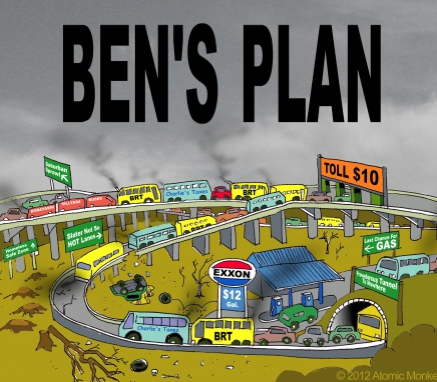
So you can imagine how thrilled we were to read Atomic Monkey’s scoop yesterday. Thanks to the Monkey (and thanks for the Monkey's permission to use its cartoons), Mr. Cayetano’s plan is revealed in all its complexity, which the story says “incorporates a half dozen ideas and technologies that have already been abandoned as obsolete, too dependent on imported oil, or just plain lolo. However, the Cayetano team insists that when all used together, they miraculously produce a superior solution."

“I always wanted to build a tunnel somewhere,” highway expert and UH Professor Panos Prevedouros told the Monkey, “so when Ben asked me what I wanted out of this, I jumped at it.”

You won’t find a better parody than Atomic Monkey’s treatment of the Cayetano Campaign’s Still-Secret Bus Rapid Transit Plan. In truth, the candidate’s failure to reveal it in full detail is no laughing matter.

Details Leak Out
Learning exactly what Mr. Cayetano has in mind after he kills mobility-restoring, travel-time-reducing, development-guiding, transportation-equity-enhancing and job-creating Honolulu rail is a deadly serious quest. Civil Beat seems to think so, too.

Writer Michael Levine reminded his readers yesterday that Mr. Cayetano “…said a detailed plan would be forthcoming in mid-April. In the weeks since that self-imposed deadline came and went, I’ve reached out to the campaign to ask for an interview to offer him a chance to share details in an op-ed and to invite him to come to Civil Beat headquarters to meet with our editors. So far, no go. But some details are slowly emerging.” 

Imagine that – a politician running away from an open invitation to provide unedited details of his campaign’s centerpiece. Any day now Star-Advertiser columnist Dave Shapiro, who devotes his space today (subscription) to yet another swipe at rail supporters, will find a way to praise Mr. Cayetano’s opaqueness on his BRT plan.

Here It Comes
Mr. Levine then quotes from a recent interview Mr. Cayetano gave to the Hawaii Filipino Chronicle. Civil Beat has a link to the entire article and quotes the most relevant paragraph on the alleged BRT plan, including this gem:

“So we’ll look at running (BRT) down King Street or Beretania Street. We may have to elevate it in certain areas but it’ll run on the freeway, so we won’t have to create a new elevated structure. When it enters Downtown, it will need a dedicated lane which may require taking away some parking here and there.”

Mr. Cayetano says the system has worked in Europe, South America and Japan, so it must be good, right? We all appreciate Honolulu’s obvious similarities with Europe, South America and Japan.

C’mon, Atomic Monkey. Now you know Mr. Cayetano is prepared to duplicate the death knell of the Harris Administration’s BRT plan – taking away car lanes and giving them to TheBus. We need a new cartoon one with cars scrunched together as an empty bus rolls by in an empty bus lane. The Parody Potential is Positively Limitless!

Tuesday, May 8, 2012

Anti-Rail Talk Show Fritters Away Most of Hour With HART CEO, which Was Fine with the Host, Then Launches Anti-Rail Rant for Rest of Show

The anti-rail morning talk show host has complained incessantly that supporters of the Honolulu rail project have never accepted his invitation to be on his show.  It’s been one of his key talking points during innumerable hours of anti-rail rhetoric on his station going back to 2005.
So when Dan Grabauskas, chief executive officer of the Honolulu Authority for Rapid Transportation (HART) did agree to appear on his show this morning, how did the host handle the prospect of having his rhetoric refuted by a man who knows infinitely more about Honolulu rail than he does? By steering the hour away from substantive issues toward the unimportant and into cul-de-sacs of his own making, that’s how. 

What was touted in advance as an hour with Mr. Grabauskas was reduced to maybe 10 minutes of substantive rail discussion, excluding the opening biographical segment (the host’s first cul-de-sac); three calls from listeners, including one from the Big Island of all places (all three voices were recognizable from previous calls as anti-railers); traffic reports, news breaks and commercials.

In other words, the hour was perfectly directed by the host to avoid both his vulnerable rhetoric and Mr. Grabauskas’ strengths.

And what made the whole charade even more outrageous was the host’s oh-so-sincere protestations that he wants to know more about rail that he made during the hour after the interview with HART’s CEO:

 “…what is this about, and why? I’m just very curious, why? What are the justifiable reasons? It was interesting when Dan talked about traffic, about a choice, about spending time with the family, about possibly selling one of your vehicles. I get that, alright, I understand where you’re coming from…. And I’m truly interested in hearing what the explanations are and what the proposals are, what the vision is and all of that…. I know there are many other issues on the table, and we’ll get to those in subsequent conversations with Dan, about the promises of transparency…about the Alternatives Analysis process, about the federal lawsuit, why he believes rail is the solution to traffic…” yadayadayada.

What a Joke
Despite all the polite talk and kid-gloves interviewing technique, let there be no mistake about the radio host’s agenda: He wants to kill rail, and he’s not the least bit interested in transparency, even-handed discussions or anything else that might shed one ray of positive light on the project.

His open-line hour following the interview was a continuation of that agenda, inviting rail opponents to say why they’re opposed to the project. There was no similar invitation to rail supporters – just a one-way rant from the host’s true believers. On cue, anti-railer-in-chief Cliff Slater weighed in for the umpteenth time to suggest rail would be a failure because congestion will continue to increase. As the City's Wayne Yoshioka once said, "No kidding...."

Thankfully, the host's listeners make up a tiny percentage of the radio audience, and we have to admit after this morning's fiasco that maybe those who say it’s not worth spending any time talking to this particular radio station are right.

But if that time ever does come again, here’s a suggestion: Tick off the host’s objections to rail one by one, top to bottom, and expose the shallowness and misinformation on each of his points – the alternative to traffic issue, congestion reduction, noise, financing, construction byproducts, energy, ridership, TOD, jobs and all the rest.

Doing that would leave the host with no place to hide but the off switch. As for his faux desire to know more about rail, it’s a dark, black joke.

Monday, May 7, 2012

Open Letter to Newspaper Reporter B.J. Reyes: The Other News Media Follow Your Mayoral Race Stories; How 'bout Covering Cayetano BRT Plan?


Dear B.J.,

As the Star-Advertiser’s reporter covering the three-man race for Honolulu mayor, you have the hottest beat in town, and by extension, that makes you one of the most influential journalists in Honolulu.

What you report on that race to a great extent determines what the other media report. It’s been that way for decades. One-time Star-Bulletin City Hall reporter Diane Armstrong and I (for the Advertiser) took bemused umbrage years ago when our coverage routinely showed up in TV newscasts later in the day.

Now that Honolulu has only one daily newspaper, you and your colleagues at the Star-Advertiser are even more influential in setting the media agenda. That’s why I’m writing this open letter to you with a hope you’ll start reporting on what looks like the proverbial “elephant in the living room” in this race.

Doing What Comes Naturally
Mayoral candidate Ben Cayetano has said he’ll install a bus rapid transit plan if he’s elected and is successful in killing mobility-restoring, travel-time-reducing, development-guiding, transportation-equity-ensuring and job creating Honolulu rail.

He alludes to that plan without providing any details – a fairly remarkable position to take in light of the magnitude of his promise. Mr. Cayetano told Civil Beat six weeks ago he’d make those details public by mid-April, but that deadline came and went with no follow-through by the candidate.

It seems obvious by now that Mr. Cayetano is doing what a lot of politicians do when they think they’re leading a race: They duck debates and don’t allow themselves to be bogged down by inconvenient details – in Mr. Cayetano’s case, his BRT plan.

109 Days & Counting
This is where you come in, B.J. Mr.Cayetano formally announced his candidacy on January 19, so it’s past time for him to own up and say exactly how he’d address Oahu’s growing congestion problem if he kills rail. He owes us more than vague references to a 12-year-old plan that was rejected a decade ago.

If it’s the Harris Administration’s BRT plan he wants to install instead of rail, the list of questions is virtually endless – and Yes2Rail started such a list at the end of a recent post.

If you question Mr. Cayetano on the “elephant” that he so far has refused to discuss, B.J., he will either provide those details or he won’t, and you’ll be in the catbird seat – reporting on his response either way and giving the other media in town something to write and talk about, too.

Good luck in snagging the details of Mr. Cayetano’s BRT plan. We’re all counting on you.

Aloha,

Saturday, May 5, 2012

Saturday Review: Anti-Rail Candidate Attracts Scrutiny for Temper and Lack of Transparency; Cayetano’s Refusal To Discuss His BRT Plan Is His ‘Glass Chin’ or ‘Achilles Heel’ – or Both; Paper Corrects Its Report on Cayetano-Inouye Flap

It takes a five-line headline to sum up the rail-related events in the week that was, starting with a lesson for your children: Bad things can happen when you don’t talk nice.

One of those things happened this week to anti-rail mayoral candidate Ben Cayetano. BeNiceBen.com was launched in response to his unflattering comments about Senator Dan Inouye, Hawaii’s exceptionally powerful senior senator who has represented the state on Capitol Hill since 1959.

Pacific Resource Partnership, described in today’s Star-Advertiser story (subscription) as “a prominent rail supporter and advocacy group for Hawaii’s unionized carpenters and construction workers,” launched the website in response to Mr. Cayetano’s suggestion that Senator Inouye is “out of touch” and flying at 30,000 feet above local issues, like rail.

“These sorts of personal attacks have no place in our public discourse,” the website says. “When Ben Cayetano disprespects Senator Inouye – a man of integrity and honor with a distinguished record of public service – he’s disrespecting all of us.”

Fits the Pattern
In one respect, the be-nice kerfuffle works to Mr. Cayetano’s advantage by diverting attention from what the campaign’s true issue – his lack of transparency about the bus rapid transit plan he says he’ll launch when he kills mobility-enhancing, travel-time-reducing, development-guiding, transportation-equity-ensuring and job-creating Honolulu rail.

That’s a recurring subject here at Yes2Rail, but it is virtually non-existent in the news media – a journalistic lapse of unbelievable proportions months into Mr. Cayetano’s campaign that defies explanation.

Why are the news media so reluctant to ask Mr. Cayetano about the specific details of his BRT plan? Has everyone from editor to reporter gone soft? Here’s a candidate who wants to wipe away years of rail planning with simplistic concepts borrowed from rail’s chief opponent, Cliff Slater.

For example, Mr. Cayetano echoes Mr. Slater’s lack of respect for the electorate by suggesting rail will fail because congestion will continue to increase long after rail is up and running. What he won’t or can’t concede is that congestion will be worse without rail than with it. Our “aggregation site” lists numerous examples of this dumbed-down rhetoric.

Do reporters need the questions to be spelled out for them? If so, here we go: (1) “Mr. Cayetano, what exactly are the details of your BRT plan, and why are you refusing to release them as you said you would by mid-April?” (2) “Will you concede that traffic congestion would be worse without rail than with it?” And (3) “Will you concede that only grade-separated transit can provide congestion-free travel for commuters, something no bus scheme – rapid or not – can achieve?”

Ask him that and the media likely won’t hear straight answers. He’ll talk about rail’s visual impacts and sewers and potholes and a "smear campaign" as he does today and potential impacts on ancestral burial sites. (Not insignficantly, an expert in Native Hawaiian legal issues defends the city’s approach to the latter in a Star-Advertiser commentary today.)

Just Say ‘Not’
The Star-Advertiser today corrected its Friday story on the Cayetano-Inouye flap, but you need an eagle eye to find it.

Yesterday’s story said: “(Mayoral candidates) Carlisle and Caldwell both defended Inouye on Wednesday and put their full faith in his ability to get the funding. Both said they did give credence to Cayetano’s ‘hypothetical’ scenario of funds running out.”

Today’s correction at the bottom of page B-2 says the word “not” was left out of that second sentence in Friday’s edition. It should have read “did not give credence….” Talk about the impact of a three-letter word.

And if you want to see who was naughty or nice in that debate, you can watch a replay on Oceanic-Time Warner’s ‘Olelo Channel 49 at 12:30 am Monday, 9:30 am Tuesday and 1:30 pm Wednesday, and on Channel 54 at 6 pm Friday.


Friday, May 4, 2012

With Anti-Rail Columnist in Cayetano’s Corner, Media’s Role in Transit Issue Looms Even Larger; Will Rail Supporters Finally Demand ’No Mas’?

Civil Beat wrote yesterday after the first debate among the three mayoral candidates that the pattern was set in how they’d conduct themselves during the campaign. One day and one additional analysis later, there can be no doubt that the attack candidate is anti-rail Ben Cayetano.
Star-Advertiser columnist Richard Borreca, who’s also anti-rail, pounded home that message today in yet another glowing Cayetano-centric commentary that surely will be posted in the Cayetano campaign headquarters.

So far this week, Mr. Borreca has compared Mr. Cayetano to William Wallace, the battle-axe wielding hero in the “Braveheart” movie, and (indirectly) to Sugar Ray Leonard, who pounded Roberto Duran into gasping “no mas” (no more) to end their famous 1980 fight.

“’No mas’ comes to mind after witnessing the pummeling former Gov. Ben Cayetano gave former acting Mayor Kirk Caldwell in the debate Wednesday night in downtown Honolulu,” Mr Borreca writes. He says Mr. Cayetano’s tactics “were tough enough” that he had Mr. Caldwell on the ropes.

What We Need?
“So finally, we are getting it all out in the open. Cayetano’s challenge gives Honolulu the debate it needs,” the column continues near its end.

What happened Wednesday night may satisfy a columnist whose meat and potatoes is politics and campaign mayhem, but it’s not what Honolulu needs in this election.

What Oahu residents need are the details of Mr. Cayetano’s intention to substitute the Harris Administration’s bus rapid transit plan as his alternative to Honolulu rail. There’s plenty of politics as usual in this campaign; what’s missing is the most essential element that Mr. Cayetano so far refuses to discuss.

Mr. Borreca ends his column with yet another reference to boxing: 

"This week’s debate showed that before they get in the ring again with Cayetano, both Carlisle and Caldwell must figure out a way to explain why they are in the race and why their election is vital, because Cayetano certainly knows what he is doing.”

He certainly does. Throwing verbal haymakers has long been the favorite tactic of this legendary political pugilist, but Mr. Cayetano’s most obvious tactic these days is back-peddling around the ring to avoid any engagement on the specifics of his BRT plan.

Fight enthusiast Mr. Borreca alluded to that tactic by observing that neither Mayor Peter Carlisle nor Mr. Caldwell laid a glove on Mr. Cayetano: “Neither…asked Cayetano to spell out his alternatives to the rail project….”

That’s the emerging issue in this campaign. Mr. Cayetano is either holding back his alleged BRT plan for later use, or he's back-peddling because there is no suitable substitute for mobility-enhancing, travel-time-reducing, development-guiding, transportation-equity-enhancing and job-creating Honolulu rail.

The weakness of his BRT plan, which was rejected the first time around, almost certainly is Mr. Cayetano’s glass chin. One or both of his opponents eventually will start swinging away at it, and the ring-side media – who so far don't bother to report on Mr. Cayetano’s back-peddling – will have to report those blows when they land.  

It’s a one-two combination that could put the tough-talking Ben Cayetano down for the count. 

This post has been added to our "aggregation site" under the 2012 Mayoral Race & Rail heading.

Thursday, May 3, 2012

Mayoral Candidates Face Off in First Debate, but One Man’s Nakedness Goes Unreported: Cayetano Still Refuses To Provide Details of His BRT Plan

Reading the Star-Advertiser (subscription) and Civil Beat stories about last night's debate among the three mayoral candidates recalled the famous tale by Hans Christian Anderson, "The Emperor's New Clothes."
You remember it: An emperor is conned by two weavers into believing the threads of the new suit they’ve made for him are so fine that they’re invisible to the unfit, incompetent and stupid. When the emperor walks among his subjects wearing nothing but his birthday suit, a child sees the truth and blurts, “But he isn’t wearing anything at all!”

Ben Cayetano, the anti-rail candidate, is going out in public with his own set of invisible threads. He’s woven an image of a bus rapid transit plan that he’d implement instead of building Honolulu rail if he’s elected. 

Trouble is, as any child can see, there is no BRT plan – just a description as vague and invisible as the emperor’s new suit. All we know is what he told Civil Beat six weeks ago: He’d resurrect the failed Jeremy Harris BRT plan that was written in 2000. What we also know from personal contacts is that the former governor is refusing to respond to media requests for details on the recycled plan.

The BRT Fable
Using the emperor’s suit again for imagery in imagining Mr. Cayetano’s BRT plan, what size is his jacket, and where exactly will the buttons be placed? Will it have wide or narrow lapels or maybe no lapels, like a Nehru jacket? Will the vents be on the sides or at the back? Will it be fitted, European style, or cut to flatter a more portly figure? Sleeve length? Inside pockets? What exactly will it look like?

The same goes for all the missing details in the former governor’s BRT scheme. He wants to kill rail, for which construction already has begun, and replace it with an unknown, invisible and totally unvetted and untested plan that will add more buses to congestion rather than reduce it.

If political science students are looking for a naked political play to study, this surely is it – the old “duck and cover” strategy used by candidates allegedly ahead in their races to avoid being dragged down by details.

Where's the Transparency?
Mr. Cayetano is avoiding the inconvenience of discussing BRT’s specifics, and that apparently includes ducking debate opportunities that might expose his invisible BRT threads.

According to Civil Beat, “Cayetano balked at having more than 10 to 20 people in the room” when pro-rail candidate Kirk Caldwell sought his commitment to participate in “three televised, open-to-the-public debates.”

He wants only 10 to 20 people in the room and for all we know no TV? And he’s committed to transparency in "solving" Oahu's traffic congestion problem with buses instead of building rail? How exactly?

Rail is the biggest issue in the 2012 campaign for mayor, so it’s incumbent on the one candidate who wants to kill rail to tell the media and therefore the public exactly what he’d do instead.

This is where the journalists in town need to step up to their responsibilities as the inquisitors for the public. How much longer are they going to wait for Mr. Cayetano to produce his invisible BRT plan?

The time for politely asking for those details has long since passed. It’s time to “demand” them, and if the candidate ignores those urgent requests, that needs to be reported, too.

Cliff Slater and other anti-rail “weavers” have created this problem for Mr. Cayetano. They’ve dressed him up in a bus-based plan that can’t possibly duplicate the contributions of mobility-enhancing, travel-time-reducing, development-guiding, transportation-equity-ensuring and job creating Honolulu rail.

Talk about naked.

This post has been added to our "aggregation site" under the 2012 Mayoral Race & Rail heading.

Wednesday, May 2, 2012

Community Turns Out for Informational Meeting; Unlikely Pairing -- Honolulu Rail & Cans of Soup, Plus: Some Questions for Candidate Cayetano

 McKinley's cafeteria was filled for the rail outreach meeting.
The first in a series of Community Information Meetings enjoyed a big turnout last evening at McKinley High School’s cafeteria. The series continues this evening at Radford per the rail meeting schedule.
 
The Rev. Bob Nakata (left) of Faith Action for Community Equity (FACE) reminded attendees before the session actually kicked off that his organization believes rail may be the last chance for Oahu to create affordable housing for this and future generations. With high rankings in electricity rates, gas prices, groceries, real estate and other indices that make up the cost of living, living on Oahu is bound to be even more expensive in years ahead. Reverend Nakata said transit-oriented development will be a key feature of the rail project, and he urged attendees to make that point whenever and wherever they can.

Once the meeting actually began, new HART CEO Dan Grabauskas (enjoying a quick bite at right) provided an overview of the project and answered questions from the floor before break-out groups delved into transit-oriented development, rail operations and other topics. The former head of the Boston transit system told the audience the elevated rail plan that’s being implemented – construction on the support columns began last week – was selected after numerous alternatives were studied years ago. Elevated rail is the only way for commuters in the east-west corridor to completely avoid traffic congestion.

No Soup for You?
One question from the floor had a familiar ring to it, since it riffed off rail opponent Cliff Slater’s stump speech. “I’ve read that traffic congestion in the future with rail will be worse than it is today,” the Makakilo resident said. “What’s the truth in that?”

The answer, of course, is that congestion would be worse without rail than with it, something Mr. Slater even had to admit before the City Council a couple summers ago. Later, in discussion, the questioner revealed the mindset that drives many who find a reason to oppose rail.

What he and they want is an absolute “solution” to traffic. He said if he’s hungry and goes to the store for a can of soup, he knows the soup can will “solve” his hunger problem. Rail shouldn’t be any different, he reasons; he believes an investment of several billion dollars should be able to wipe away traffic, just as a can of soup wipes away his hunger.

It’s an inventive way to find fault with rail, but our conversation reminded us that leading a horse to water won’t necessarily result in drinking. When someone is dead set against the project, there’s little likelihood “truth-telling” will get through – even the obvious truth that Oahu’s population will continue to grow and so will the number of vehicles, all resulting in more traffic congestion than we have today. Rail and nothing else will "solve" congestion.

With little enthusiasm on Oahu – let alone the space – for building more highways here, rail will allow users avoid the inevitable growth in congestion. But equating congestion with hunger and thirst may not be so off the mark after all. Sooner or later, we simply must eat and drink to overcome both – either that or die.  Traffic congestion already has reached unacceptable levels for commuters, and a daily diet of riding Honolulu’s future train will help them cope with it by avoiding it.

Questions for Ben
Anti-rail mayoral candidate Ben Cayetano will hold another of his chilli-and-rice dinners this week. It’s billed as an “ask the candidate” event, so here are the top three questions that need asking:

1. “You say rail won’t solve the traffic problem, but isn’t it true congestion would be worse without rail than with it?”
Answer: If he’s truthful, Mr. Cayetano will have to answer in the affirmative. He’s taking his cues from Mr. Slater (see above), and in so doing, there’s no other way to answer it truthfully.

2. “Isn’t it true that the bus rapid transit plan that you’re borrowing from the Harris Administration wouldn’t end the congestion problem?”
Answer: If he’s truthful, Mr. Cayetano will have to admit that. Adding more buses to already congested roads and highways can’t possibly reduce the inevitable growth in congestion.

3. “When will you do the right thing and publicize the details of the BRT plan you want to implement if you’re elected after you’ve killed mobility-enhancing, travel-time-reducing, development-guiding, transportation-equity-enhancing and job-creating Honolulu rail?”

We don’t know the answer to that one. Only Mr. Cayetano knows. He formally announced his candidacy 104 days ago on January 19. There are only 101 days to go before the primary election, which means Mr. Cayetano has managed to stall for more than half the time between announcement and election.

Of course, his supporters don’t care about his BRT plan, since most are really concerned only about killing rail. He represents their best chance to achieve that goal, but what about the media? Do reporters care?

We heard from one reporter who’s closely following rail that he’s been asking Mr. Cayetano for the BRT plan's details, and the candidate is refusing to respond to his inquiries. Is that the brand of transparency Mr. Cayetano is proposing in his administration?

That qualifies as another question, so we’re obligated to provide the Answer: Only if the media and public let him get away with it.

Tuesday, May 1, 2012

New Transit Chief Meets Public Starting Tonight, Lays Out Rail Rationale on Perry & Price Show: Commuters ‘Are Going To Use It and Love It’

Mr. Dan Grabauskas, the new chief executive officer of the Honolulu Authority for Rapid Transportation, has been on the job three weeks and is wasting no time living his message of project transparency.

Mr. Grabauskas will be the principal speaker at tonight’s Informational Community Meeting from 6 to 8 o’clock in the McKinley High School cafeteria. Other evening sessions will be held over the next week in and near communities whose residents will be served by the rail project.

He’s also talking with the news media, including the top-rated Perry and Price Show on KSSK this morning. Here’s a partial transcript:
Grabauskas: You pretty well see that the road system is broken. (After) having added more lanes and focused on the Zipper lane, we’ve just reached a point of capacity or incapacity on those roadways, and there’s not a lot of room left. What we try to do is look at all alternatives, and there have been a number of alternatives looked at. I’m excited, and I’m here because I feel the rail alternative that’s been voted on and decided is a really positive thing to do. My experience throughout the country is such that when you get this kind of density and this kind of traffic – and frankly, maybe uniquely here, the price of gas – you really see that it’s an absolute waste of time and money sitting in traffic, and rail can be a solution to that.
Larry Price: We pretty much go along with the idea. It seems like everybody is pulling for it and everybody wants it, and now, the City Council is coming up with a bill that’s going to give you 450 million dollars in low-interest loans for unforeseen problems that occur. Is that typical?
Grabauskas: As people may know, the rail project construction is funded by the half-a-percent (increase) of the (General Excise Tax), and the Hawaii congressional delegation will get another one point five five billion dollars from the federal government. The money being debated right now in front of the City Council is a requirement by the Federal Transit Administration that all new projects identify a contingency in the event of some unforeseen circumstances so that you are able to complete the project after having invested locally and federally these billions of dollars. The money that’s being tapped is described in front of the Council literally as money we hope we’ll never use. It’s only for unforeseen circumstances.
Mike Perry: I think a lot of people are still under the misconception that when we get rail, traffic will be better than it is now. Traffic will never be better than it is right now. It will be – with rail – less worse. Is that a reasonable way to state it?
Grabauskas: What we’re hoping to do is to see anywhere between a 15- and 20-percent decrease in the traffic on the roads, so you’re still going to have a very challenging system, which would certainly be true if you tried to add buses into traffic. The real goal with the rail is to have an opportunity to have (transit-oriented development) concentrations along the rail corridor where more people can (live and) ride rail and get to and from their jobs (instead of) having to get on the H-1 in traffic.
Perry: And can we afford to maintain this rail? Will this be something going forward that will not bankrupt the City and County?
Grabauskas: Absolutely. I come from Boston, where we had the oldest rail system in the United States chugging along for 114 years at this point, and it has been only a boon to the city. The city of Boston and other cities around the country and world, when they reach the level of density that we have here, with as many people crowded into a very narrow corridor, it’s a real plus. I don’t think you can afford not to (build rail), given what the traffic is, and we’ll all have to be creative (with) even further solutions in the future if we’re going to have sustainable development.
Price: So when are you going to take on some of these people who are adamant about not having the rail system, like the (former) governor and people on the windward side? Are you going to go out to the public and actually show them the X’s and O’s?
Grabauskas: Absolutely right, and in fact, we’re starting tonight at McKinley High School cafeteria from 6 to 8. We’ll be having an informational community meeting, and then we’ve got one on Wednesday evening at Radford High School cafeteria in Salt Lake, and on Thursday from 6 to 8 at Farrington High School cafeteria in Kalihi, and two more next week. If people are interested in any information about those meetings, they can call 768-6159, or better, just go to HonoluluTransit.org.
Perry: This is a confusing thing for the people of Hawaii. We’re still pretty agnostic about the whole thing because we don’t know. Does anybody know, going forward, how a rail system will work? Some are total disasters, there are some that work, and really, we don’t know. You are saying that you have pretty good confidence in fact that this one is going to be all right.
Grabauskas: From everything I’ve seen about this project, I see it as a real big plus. It’s going to give relief to people in West Oahu, the relief that’s been promised to them for a long time. I’m looking at this as a way to relieve the most unproductive time that I see being spent anywhere on the island, and that is traffic every morning and traffic every afternoon and traffic in the middle of the day now. So if we can do something to give people a reliable 40-minute ride from Kapolei to downtown, I think they’re going to use it and I think they’re going to love it.
Perry: Dan, I have a feeling we’ll be talking to you a lot in the next several years.
Grabauskas: I look forward to it. Thanks very much, Mike and Larry. I appreciate it. Happy May Day and Lei Day.

Yes2Rail: Our sentiments exactly!