Sunday, January 30, 2011

Honolulu Rail Has ‘Big Mo’ on Pro Bowl Sunday

Add today’s Honolulu Star-Advertiser editorial section support and exposure to the list of recent Honolulu rail achievements and it’s clear the rail team has momentum is on its side.

The project has racked up a remarkable list of achievements in the past six and one-half weeks – FEIS acceptance, Programmatic Agreement signing, Record of Decision issuance and the granting of a needed SMA permit.

That’s an impressive offensive line to take on the anticipated legal challenges anti-railers surely will mount.

As today’s editorial headlines, the project’s “next stop” is creation of the Rail Transit Authority – officially the Honolulu Authority for Rapid Transportation, quarterback of our Rail Transit Team.

We’re obviously stretching to connect with the NFL’s Pro Bowl, which will kick off a few hours from now in Honolulu’s Aloha Stadium, about three strong-armed quarterback throws from rail’s future station.

We predicted two years ago rail’s groundbreaking would occur before the next Pro Bowl was held here. Well, that’s today, and groundbreaking is still a few weeks away, but we’re confident in this fresh prediction – that by the next NFL game at Aloha Stadium, Honolulu will be well along in finally building this long-sought mobility-enhancing project.

Saturday, January 29, 2011

Houston At-Grade Rail Gets Safety Repackaging

Despite Honolulu rail’s recent successes – the FEIS’s acceptance by the Governor, signing of the Programmatic Agreement, the FTA’s issuance of a Record of Decision and the City Council’s award of an SMA permit – we just know someone will insist the project would be cheaper if built at ground level.

With that in mind, we’re returning to a frequent Yes2Rail theme – safety – by checking in with Houston, TX, which is scrambling to make its at-grade rail system safer.

Earlier this month, Houston’s METRORail unveiled a wrapped train (pictured above) that implores vehicle drivers to pay attention to approaching trains. Too often, drivers don’t, and the results are themselves eye-catching, as we showed here last February.

Honolulu’s trains will run on tracks elevated about 30 feet above ground level. We’ll never experience events like what the citizens of Houston and Phoenix, AZ have almost come to expect.

That’s why officials are wracking their brains for safety campaigns, for example, wrapping their trains. Looks like they gotta do what they gotta do.

Thursday, January 27, 2011

Council Action Clears Path to Rail Groundbreaking

The vote was unanimous among all Council members who were present for the vote – 8 to 0 in favor of granting a Special Management Area (SMA) permit to the Honolulu rail project. One member was absent.

Despite reservations and even firm objections to building rail by a minority of Council members, those opinions did not carry over to the vote on the final major Council action required for the project to proceed, which is now expected to break ground by March.

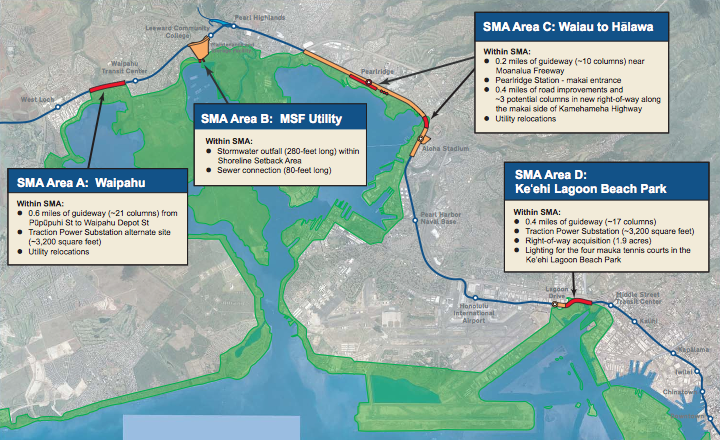
SMA permits are required for certain kinds of alternations and developments within areas designated by the State's Coastal Zone Management Program.

About 1.6 miles of Honolulu rail’s 20-mile route will be within the coastal management area (see details on above map) as defined by Oahu ordinance.

Wednesday, January 26, 2011

Let’s End this ‘Bridge to Nowhere’ Talk Right Now!

Anti-railers must be thinking, “It worked in Alaska. Maybe we can make it work here, too!”

Their latest essay – “Still Hope for Rail Critics” – is another of their flawed commentaries that Yes2Rail likes to highlight; the more exposure their thinking receives, the stronger the case for Honolulu rail. (See our July and October 2010 Yes2Rail posts for more highlighting of anti-railers' spurious arguments.)

***********************************************
6 pm UPDATE: Council Approves Key Permit for Rail
***********************************************

Take this commentary, please – and let’s take it apart piece by piece for the benefit of those who might be reading their stuff at a distance.

This isn’t a bridge to nowhere; it’s a link between urban Honolulu and the region in the southwest corner of Oahu that has been designated for decades as the location for future growth as our Second City.

The region, referred to generally as the new city of Kapolei on the Ewa Plain, is where young families can afford to rent or purchase their first home. Oahu is one of the most expensive real estate markets in the nation, so less-expensive housing developments in Kapolei are attractive and can only increase in size.

This map shows an arrow pointing to Kapolei. Note that Oahu is an island in the middle of the Pacific Ocean. We have one major east-west route, the H-1 freeway; it's not possible to build south of that route for the obvious reason that the space is wet. Mountains (not shown) prevent inland routing.

The H-1 already is clogged with traffic during drive time and often throughout the day, but building more highways to relieve that traffic pressure on a land-scarce island is not the answer, no matter what anti-railers say.

Government officials for decades have proposed a grade-separated rail link between Kapolei and Honolulu as a way to restore mobility. That’s one of the rail project’s goals – to restore what our population has lost, the ability to move at will through the urban corridor.

Other project goals include improving access to the planned development of the Second City, as noted above. A third is improving corridor travel reliability, which grade-separated transit does nicely by completely avoiding surface congestion. Improving transportation equity is a fourth goal, giving all segments and economic groups access to fast, frequent, reliable and safe travel regardless of age and income.

This Is Not a Jobs Project!

But the “Still Hope” commentary ignores all that and wants you to believe this is nothing more than a jobs project. “The promise of creating jobs is not a legitimate excuse for every piece of large-scale government spending that worms its way into the budget,” it says.

Of course jobs will be created, but that’s not why Honolulu rail is proceeding. Anti-railers would have you believe otherwise, just as they automatically assume “cost overruns in the billions of dollars….”

It’s part of their mantra, just like the “bridge to nowhere” chant. And just like most glib and easy-to-swallow slogans, this one is easily debunked.

Monday, January 24, 2011

Governor Says State Will Support Rail’s TOD Effort

Governor Neal Abercrombie delivered his first State-of-the-State Address this morning and continued his endorsement of Honolulu rail by pledging State support for transit-oriented development along the project’s 20-mile route:

“The New Day Work Projects will look to the future and what our community and our economy will look like decades from now. For example, as Honolulu moves on its transit plans, the State will actively encourage and support attractive, sustainable transit-oriented development. The Legislature has proposals on these concepts, including looking at density rights and other zoning initiatives. I will look forward to participating in these discussions and moving quickly. The people of Hawaii are going to get to work and build our future.”

In an allusion perhaps to federal monies that are anticipated to help build Honolulu rail, Abercrombie continued:

“In meetings with other governors across the country I’ve met some who have an ideological problem with utilizing resources from the federal government and collaborating with the President. We of course have no such problem. After all, federal dollars are our tax dollars, and we should pursue our fair share vigorously and strategically.”

Thursday, January 20, 2011

Congressman John Mica (R): ‘I Support this Project’

Rep. John Mica, new Chairman of the Republican-controlled House Transportation and Infrastructure Committee, told Honolulu Mayor Peter Carlisle today he likes what he sees with Honolulu rail.

“I support this project,” Mica said, “especially with Honolulu’s local commitment, and I will continue to work with Rep. Hirono and the Federal Transit Administration to make sure the project does not get bogged down in bureaucratic red tape.”

Mica’s comments reflected his familiarity with Honolulu’s unique geography, which federal authorities for decades have said is a near-perfect fit for a rail line that would be a transit "spine" along the length of the city, with feeder bus routes connecting to the elevated train stations.

“Honolulu is bordered by the mountains on one side and the ocean on the other,” he said. “This project will service the area where the vast majority of Oahu’s population live and work and will help address the area’s traffic congestion issues.”

The project’s final environmental impact statement projects daily ridership of the grade-separated system of 100,000-plus, resulting in at least 30,000 fewer cars on Honolulu streets and highways each day from what would be the case if rail were not built.

According to a press release issued by Carlisle’s office, the Mayor also met today with Rep. John Duncan (R-TN), Chairman of the House Highways and Transit Subcommittee; Rep. Peter DeFazio (D-OR), Ranking Member of the subcommittee, and Rep. Nick Rahall (D-WV), Ranking Member of Rep. Mica’s committee. Carlyle’s release said all “expressed their willingness to work with the City and County of Honolulu as it advances its rail project.”

“I am very pleased and grateful to Rep. Mica for his continuing support for the Honolulu Rail Transit Project,” Carlisle said. “Receiving the Record of Decision was a tremendous step forward for Honolulu, and Rep. Mica has offered to help us continue our implementation and expedite the construction of our project by working with the FTA, Rep. Hirono, our entire Congressional Delegation and the U.S. Congress.”

Editorial: Rail Project Needs Public Buy-In

“All of the steps along the way (of building the rail project) must be taken with a full measure of public notification; transparency at each stage of the project is of immeasurable importance to maintain public trust in the expenditure of some $5.5 billion on Hawaii's largest-ever taxpayer-funded project….
“But the residents already living (near the future stations) need to buy into this, too. If stops are envisioned well, these live-work-play complexes will become less of a jarring intrusion and more of an integrated addition to established neighborhoods. The community embraces what it's helped to design, making the improvements vibrant and lasting.” ~ Honolulu Star-Advertiser editorial, 1/20/11

What’s not to like about this editorial? It summarizes the Honolulu rail project's guiding principle from the start, notwithstanding complaints from some about being shut out of the process. They presumably feel that way because (1) they’re rock-ribbed rail opponents or (2) their proposed route/technology/you-name-it wasn’t selected.

With the Federal Transit Administration overseeing this project each step of the way, there’s no way the City has or would short-circuit the process. I’s have been dotted and T’s crossed. Count on it.

Wednesday, January 19, 2011

Sure-Fire Path to Paralysis: Foment Fear of Failure

We didn’t have to wait long for the anti-rail segment of our island society to chime in on the Federal Transit Administration’s issuance of a Record of Decision to the Honolulu rail project.

Their mantra is what they’ve used for at least 20 years; we call it the What-If Factor. What if the federal money never comes? What if there are cost overruns? What if there are delays? What if there’s a tsunami? Believe it or not, fear-of-tsunami has been mentioned as a reason not to build Honolulu rail.

A morning radio talk show host and his favorite anti-rail guest were perfecting their What-Ifs this morning, going so far as to predict massive cost overruns and no federal money in the end.

It’s all boogey-man talk – conjured-up images of future failures based on nothing more than their active imaginations. Their end game, of course, is to scare citizens away from rail.

Devil in the Details

The talk show host asked his favorite guest this morning if any form of rail is acceptable on Oahu. The guest wavered slightly, since he doesn’t want to alienate a faction of local architects who favor building at grade in town and elevated further west.

But in the end, when pressed by the anti-rail host, the guest firmly endorsed building an elevated toll road instead of rail. He said drivers could pay a toll for the new highway in the sky, thereby producing reduced congestion on the H-1 freeway.

That was his alternative – diverting vehicle traffic from the H-1 freeway to the toll road. Drivers who can afford to pay tolls would do so, and those who can’t afford the tolls would be left to their on devices on traffic-choked streets and highways.

And what happens if the toll road becomes congested with too many toll-paying cars? That’s simple enough; just keep raising the real-time toll until only those who can afford to pay them would access the highway.

Just Charge More

You see where this is going, don’t you? The favored guest’s alternative to rail amounts to a failure to achieve the rail project’s four goals that we highlighted earlier this month, with "restoring mobility" the primary goal.

What also jumps out especially is a toll road’s inability to provide transportation equity for all classes of people, something rail will do with ease. Only those with cars can use toll roads, and only those who can afford to pay ever-increasing tolls can enjoy clear sailing.

Another anti-railer made all this perfectly clear in October when he wrote: “Higher tolls are necessary to discourage overloading.” So fervent is he in his defense of car-centric commuting that he probably doesn't perceive the injustice in his shockingly frank statement.

To paraphrase: “More fear of failure is necessary to encourage doubt about rail.”

Be ready for much more What-If fear mongering in the weeks, months and years ahead.

Tuesday, January 18, 2011

FTA Issues Record of Decision for Honolulu Rail!

Today’s issuance of a Record of Decision by the Federal Transit Administration was one of the most significant events in Honolulu’s decades-long attempt to build a modern rail transit system.

FTA Administrator Peter Rogoff presented the document to Honolulu Mayor Peter Carlisle and Toru Hamayasu, general manager of the City’s Rapid Transit Division, at FTA offices in Washington, DC. Said Rogoff:

“Today marks an important milestone in Oahu’s quest to become a more transit-friendly island. With the completion of the National Environmental Policy Act process, the City of Honolulu has met all of the laws and regulations of the environmental review, and we look forward to the day when Honolulu’s citizens can ride the rails in comfort, breathe cleaner air and avoid getting stuck in time-wasting traffic jams.”

Carlisle also spoke of rail’s potential “to provide residents with a sensible alternative to our congested roads and highways and improve their overall quality of life.” Carlisle noted construction of Honolulu’s 20-mile system “will also create thousands of jobs and fuel our state’s economy. It’s time to get those shovels in the ground.”

Events have moved quickly since Governor Neil Abercrombie accepted rail’s final environmental impact statement on December 16, a crucial step that Abercrombie’s predecessor had refused to complete.

“The Record of Decision) is a huge accomplishment and reflects the strong confidence the FTA has in this project,” Carlisle said in a statement. “Our transit team has worked closely with FTA throughout the process, and this shows that our plan is sound and our project is on solid footing.”


A number of other steps are required before construction can begin on Phase 1 of the project.

Walking, Transit Part of Millennials’ Preferences

Continuing the thought from yesterday – the one about the importance of not excluding Oahu’s future generations from the rail discussion (see post immediately below) – a recent Wall Street Journal piece seems especially relevant to Honolulu's plans for transit-oriented development (TOD) and Generation Y's likelihood to embrace Honolulu rail.

Reporting on a National Association of Home Builders conference, the article says “Gen Y” (born between 1980 and the early 2000s) are into urban-style living, walking and transit.

They’re not into living like their parents in suburbia – at least, not yet. “….since cities themselves can be so expensive, places with shopping, dining and transit….will do just fine,” according to the article.

Reading this piece suggests Gen Y will embrace living in newly designed communities built around rail stations. Fast, frequent, reliable and safe rail transportation will satisfy their mobility needs.

As the WSJ piece says in its opening paragraph, Gen Y doesn’t want dependence on a car. Unlike their parents (apparently), they won’t mind walking to a station to make a fast traffic-free trip.

Monday, January 17, 2011

Missing at LWV’s Anti-Rail Event: Oahu’s Youth

What would happen if the League of Women Voters held a “Doing Rail Right” panel and nobody under 30 showed up? That’s essentially what happened Saturday morning if “nobody” can be defined as “less than two.”

It’s probable Oahu’s youth stayed clear of the event (except for one anti-rail college student) because of LWV’s reputation opposing Honolulu rail. Also opposed to the project were all but one member of the event's panel.

With its reputation preceding it, the League and its decidedly senior age distribution wasn’t likely to create a buzz among the next generation of leaders on a beautiful Saturday morning. The only “independent” voice on the panel was a Civil Beat reporter who said the online news organization has taken no stand on rail and neither would he that day.

Other panelists included a member of Stop Rail Now; a University of Hawaii economist who authored a study that has been criticized by a frequent pro-rail contributor; an attorney who voiced objections to the project because of its potential to disturb buried human remains; an architect who advocated building an at-grade rail system, and a moderator who urged continued opposition to the project at the City Council level.

Generation Relevant?

Yes2Rail attended the event and is giving it more space here than the Honolulu Star-Advertiser did the next day. Unmentioned in the newspaper’s report was the age range of the participants, which we think is significant.

Of the 24 audience participants, one was a member of “generation next.” Most were a lot closer to the Yes2Rail writer’s age, which we mention only to pre-empt accusations of “ageism.”

We noted the age differential between rail opponents and supporters back in July when the City Council held a hearing on rail’s final environmental impact statement. The opponents were represented principally by Cliff Slater; Oahu’s youth testified in favor of rail.

A Kamehameha Schools graduate who’s attending Yale University said: “I support rail development in Hawaii because I want to return home. I want to have a reason to be back here. Without innovation, without a look to the future, without development that can make us a competitive force in the Pacific region and the United States, there’s no reason for students to want to come back from the mainland.”

Another young person said he represented a group called “We Will Ride.” “We represent over 400 young people, mostly high school- and college-age students that are dedicated to the promise that rail transit has for the future of Honolulu…. So essentially, I’m here and we’re here to tell you all and to tell the people and the Council that if you build a rail system, we will ride it.”

We said back in July that if the Council members were paying attention, they saw and heard the future, and it was decidedly with rail. The two Council members and one member-elect at Saturday’s event did not see or hear what Oahu’s youth want for their future. It simply wasn’t in the cards because the League had no interest in exposing that side of the debate.

Surely the full City Council can't ignore it.

Friday, January 14, 2011

Poster Contest Shows Gen-Next Appreciates Rail

First Place Winner: John Paul Nartalez, Farrington HS
We have no way of knowing how old the anti-railers are who post their comments (always negative) below the Star-Advertiser’s online rail-related editorials (always positive), stories and letters. Judged by their comments, they aren’t teenagers.

Contrast their world-weariness with the optimism found in the posters submitted by Oahu teens for Honolulu rail’s 2010 poster contest. We’re featuring the top three places at Yes2Rail today, as announced this morning by Mayor Peter Carlisle on KHON-TV2.

The winners: First Place, John Paul Nartatez, Farrington High School; Second Place, Erica S. Buxton, Farrington High School; Third Place (tie), Catherine Johnny, Campbell High School, and Kody Castillo, Radford High School.

Nartatez has won an Apple iPod Touch for his poster, which he titled “Should Have Caught the Rail.” All contest submissions are posted at the Moving Us Forward website and the Youth Council on Rail Facebook page.

A theme that runs through many of the posters is another contrast – the one between fast, frequent, reliable and safe rail transit and the traffic-choked streets and highways below.

The next generation knows continued reliance on single-occupancy vehicles (the norm today) is not sustainable in the decades ahead. Hawaii’s gas prices are the nation’s highest. We already have predictions that oil’s price could rise to $150/barrel next year! What it might be in 20, 30 and 40 years from now is beyond comprehension.

Today’s youth see the light and will lead the way – just as soon as the rest of us get out of it.
Second Place: Erica S. Buxton, Farrington HS
Third Place (tie): Catherine Johnny, Campbell HS
Third Place (tie): Kody Castillo, Radford HS

Thursday, January 13, 2011

No Surprise in State DOT’s No-Show at Council

The City Council held a hearing yesterday on the Lingle Administration-sponsored financial study of the Honolulu rail project. The State Department of Transportation was asked to participate but didn’t.

That’s not a surprise. Governor Linda Lingle (R) was adamantly opposed to Honolulu’s grade-separated rail system and made that clear at every opportunity. Her politics were 180 degrees in opposition to former Mayor Mufi Hannemann, rail’s biggest champion over the past several years and potential general election opponent of Lingle’s lieutenant governor.

Newly installed Governor Neil Abercrombie (D) is a rail supporter. He accepted rail’s FEIS 10 days into his term, something Lingle refused to do. His administration didn’t order up the IMG study; Lingle’s did. It seems understandable that Abercrombie’s Department of Transportation didn’t respond to a request to participate in the Council’s hearing on an issue Abercrombie has said was outside the State's responsibilities for rail.

The City’s Department of Transportation Services did show up to rebut IMG’s study, as summarized in its document:

While the IMG report purports to focus on the financial implications of the City’s rail transit project, much of the report discusses bus issues that are independent of the rail project. Concerning both bus and rail, the report’s conclusion of a resulting $1.7 billion shortfall is not adequately substantiated. A review of IMG’s methods show that important and more relevant data was not recognized or considered and the report’s authors used incorrect figures and assumptions that allowed them to reach unsupported conclusions. The report also reflects a lack of understanding of transit financials and fails to recognize key economic indicators used by the State of Hawaii. This further reinforces the City’s position that the rail transit Financial Plan is sound. In addition, the FTA has already reviewed the City’s Financial Plan, and found the project to be financially sound and allowed it to move forward. The FTA also continually reviews the project’s Financial Plan and will do so again as the project enters its next phase of Final Design.

Tuesday, January 11, 2011

Transportation Equity Rounds Out Rail’s 4 Goals

We’re concluding our New Year's review of Honolulu rail transit project goals today with goal #4 – to improve transportation equity.

Equity is a good filter to use when evaluating anti-railers’ alternatives to the rail project, such as High-Occupancy Toll (HOT) roads and elevated busways that lack stops or stations along the route.
********************************************
1/12 UPDATE: Hawaii Gas Nation's Costliest
********************************************
Continuing Oahu’s heavy reliance on automobiles for commuting between the Second City and Honolulu is objectionable on many levels, including the equity issue. HOT lanes fail the equity test by not serving those who don’t own cars; beyond that obvious point, HOT lanes serve only those who can afford to pay the toll! And elevated busways that bypass communities along the route also fail to equitably serve all potential users.

Rail transit meets that test. Here’s the final environmental impact statement’s description of the equity goal:

Equity is about the fair distribution of resources so that no group carries an unfair burden of the negative environmental, social, or economic impacts or receives an unfair share of benefits. Many lower-income and minority workers who commute to work in the PUC (Primary Urban Center) Development Plan area live in the corridor outside of the urban core. Transit-dependent households concentrated in the Pearl City, Waipahu, and Makakilo areas (Figure 1-9) rely on transit availability, such as TheBus, for access to jobs in the PUC Development Plan area. Delay caused by traffic congestion accounts for nearly one-third of the scheduled time for routes between Ewa and Waikiki. Many lower-income workers also rely on transit because of its affordability. These transit-dependent and lower-income workers lack a transportation choice that avoids the delay and schedule uncertainty currently experienced by TheBus. In addition, Downtown median daily parking rates are the highest among U.S. cities, further limiting access to Downtown by lower-income workers. Improvements to transit availability and reliability would serve all transportation system users, including minority and moderate- and low-income populations (emphasis added).

Monday, January 10, 2011

Rail Goal #3 – Support for Second City’s Growth

We’ve begun the New Year with a review of Honolulu rail goals as described in the project’s final environmental impact statement. A refresher course can’t hurt in these changing times.

We’ve covered two goals so far – restoring mobility and improving transportation reliability to the community. Today we’re highlighting goal number three on the list – improve access to planned development to support City policy to develop a second urban center.

That’s a mouthful, but cut down to basics, it means the Second City of Kapolei will have a better chance of developing successfully as stipulated in the City’s General Plan if it’s connected to Oahu’s urban core by a fast, frequent, reliable and safe rail system.

Consider the options to connecting fast-growing Kapolei and surrounding neighborhoods with Honolulu: (1) continued reliance on the private automobile and a narrow network of traffic-choked streets and highways, or (2) an elevated rail system that completely avoids all surface congestion, runs on a reliable timetable and delivers riders comfortably to their destinations at a time of their own choosing.

Here’s the FEIS’s discussion on the “growth support" goal:

"Consistent with the Honolulu General Plan, the highest population growth rates for the island are projected in the ‘Ewa Development Plan area (comprised of the ‘Ewa, ‘Ewa Beach, Kapolei, Kalaeloa, Honokai Hale, and Makakilo areas), which is expected to grow by approximately150 percent between 2000 and 2030. This growth represents nearly 50 percent of the total growth projected for the entire island. The communities of Wai‘anae, Wahiawā, North Shore, Windward O‘ahu, Waimānalo, and East Honolulu will have much lower population growth of up to 23 percent, if infrastructure policies support the planned growth rates in the ‘Ewa Development Plan area. Kapolei, which is developing as a “second city” to Downtown, is projected to grow by more than 350 percent, to 55,500 people, the ‘Ewa district by more than 100 percent, and Makakilo by nearly 125 percent between 2000 and 2030.
"Accessibility to the overall ‘Ewa Development Plan area is currently severely impaired by the congested roadway network, which will only get worse in the future. This area is less likely to develop as planned unless it is accessible to Downtown and other parts of O‘ahu; therefore, the ‘Ewa Development Plan area needs improved accessibility to support its future planned growth."

Thursday, January 6, 2011

Rail’s All-Important Goal – Improved Reliability

With so many new people in key government positions on Oahu, the times indeed are a-changin’, as Bob Dylan observed several decades ago. We’re taking pains to note early in 2011, however, that Honolulu rail’s goals are unchanged and as important as ever.

Tuesday’s post highlighted the mobility restoration goal, and today we’re focusing on #2 in the final environmental impact statement list – to improve corridor travel reliability. We’ve banged away at the reliability issue for as long as Yes2Rail has been on the ‘net, since it’s so easily appreciated by commuters who’ve lost it.

The significant and obvious benefit of grade-separated transit – elevated rail in Honolulu – is that it’s completely immune to traffic congestion on highways and local streets. Subways and elevated systems run on timetables that are highly reliable, unlike surface transit modes.

Riders know with a high degree of certainty exactly when their train will arrive at every station on the route, and that means they can accurately predict their destination's arrival time before they even depart.

Travel that requires mingling with surface traffic does not allow users to make such a prediction; that includes at-grade rail, HOT lanes, buses, taxis and of course, the privately-owned vehicle. Only grade-separated transit does, and that’s why goal #2 is second to none. Here’s how it’s described in rail’s FEIS:

As roadways become more congested, they become more susceptible to substantial delays caused by such incidents as traffic accidents or heavy rain. Even a single driver unexpectedly braking can have a ripple effect that delays hundreds of cars. Because of the operating conditions in the study corridor, current travel times are not reliable for either transit or automobile trips. Because TheBus primarily operates in mixed traffic, transit users experience the same level of travel time uncertainty as automobile users. To arrive at their destination on time, travelers must allow extra time in their schedules to account for the uncertainty of travel time. During the a.m. peak period, more than one-third of bus service is more than five minutes late. This lack of predictability is inefficient and results in lost productivity or free time. A need exists to provide more reliable transit services (emphasis added).

Tuesday, January 4, 2011

Taking a Closer Look at Anti-Railers’ Ace Card

What's the chief anti-railer argument against Honolulu rail? They use a scatter-gun approach, but if you listen to their radio programs and read their anti-rail columns, most of their opposition seems to boil down to an assertion that the project’s return on investment is too small.

Anti-railers argue that rail’s allegedly small reduction in total vehicle miles traveled on Oahu can’t justify the investment in the project. Let’s look at how they reach that conclusion.

You can make any argument you want through selective use of statistics. Books have been written on the practice; How To Lie With Statistics and Damned Lies and Statistics are two of them.

Anti-railers focus on the anticipated reduction in vehicle miles traveled throughout Oahu -- admittedly a low percentage -- while refusing to acknowledge rail’s biggest fact:

Rail’s impact on traffic through the urban corridor will be significant – approximately 18 percent less traffic with rail than without it. That will be the inevitable result of attracting more than 100,000 riders each day.

Anti-railers won’t touch this fact either: Rail transit will give its riders congestion- and traffic-free travel through the urban corridor. That’s an inarguable fact that anti-railers run from, can’t debate and never discuss.

The Mobility Factor

This point is huge. It can’t be repeated often enough. It must be raised whenever anti-railers spout statistics. It’s why the project’s final environmental impact statement lists mobility first among the project’s four goals, as we briefly discussed yesterday.

Here’s the mobility quote from the FEIS’s list of goals:

Motorists and transit users experience substantial traffic congestion and delay at most times of the day, both on weekdays and on weekends. Average weekday peak-period speeds on the H-1 Freeway are currently less than 20 mph in many places and will degrade even further by 2030. Transit vehicles are caught in the same congestion. In 2007, travelers on Oahu’s roadways experienced 74,000 vehicle hours of delay on a typical weekday, a measure of how much time is lost daily by travelers stuck in traffic. This measure of delay is projected to increase to 107,000 daily vehicle hours of delay by 2030, assuming implementation of all planned improvements listed in the ORTP (Oahu Regional Transportation Plan) (except for a fixed-guideway system). Without these improvements, the ORTP indicates that daily vehicle hours of delay would increase to 154,000 vehicle hours.
Currently, motorists traveling from West Oahu to Downtown experience highly congested traffic during the a.m. peak period. By 2030, after including all the planned roadway improvements in the ORTP, the level of congestion and travel time are projected to increase further. Average bus speeds in the study corridor have been decreasing steadily as congestion has increased. TheBus travel times are projected to increase through 2030. Within the urban core, most major arterial streets will experience increasing peak-period congestion, including Ala Moana Boulevard, Dillingham Boulevard, Kalākaua Avenue, Kapiolani Boulevard, King Street, and Nimitz Highway. Expansion of the roadway system between Kapolei and UH Mānoa is constrained by physical barriers and by dense urban neighborhoods that abut many existing roadways. Given current and increasing levels of congestion, an alternative method of travel is needed within the study corridor independent of current and projected highway congestion (emphasis added).

Total congestion-free travel – that’s what restoring mobility in our community will achieve. You can follow this debate closely and not once hear anti-railers acknowledge this central fact. Their “I won’t ride it, so why should I pay for it” argument doesn't help them either, since it betrays a “me first” mentality that rejects a broader vision that supports the entire community.

Congestion-free, fast, frequent, reliable and safe transportation is what rail will offer its riders. Rail’s ability to reduce vehicle miles traveled in Kahuku on the North Shore may not be much, but its positive impact in town where our congestion problem continues to grow cannot be denied.

Monday, January 3, 2011

Rail’s Goals Remain the Same in the New Year; Congestion-Free Travel through Town Tops List

Honolulu rail is poised for major advancement early in 2011. With Governor Abercrombie’s acceptance of rail’s final environmental impact statement last month only 10 days into his new term, the project now awaits three more key steps.

The first is final signing of a “Programmatic Agreement” that stipulates how impacts are to be lessened on historic sites along the project’s 20-mile route.

Once that document is finalized among the parties, the Federal Transit Administration will be able to issue a Record of Decision on the project. The ROD will state the FTA’s determination that all environmental steps have been completed in the project planning phase. It will summarize the mitigations and identify alternatives that were considered.

The City Council already has scheduled hearings on the third step – issuance of a Special Management Area use permit. About 8 percent of the project will lie within the shoreline protection zone, thereby requiring an SMA permit. The Council’s hearings will be held Wednesday and Thursday of this week.

Reviewing the Goals

Mayor Peter Carlisle anticipates breaking ground on the project sometime in the first quarter of the year, a milestone moment in the long process to build grade-separated transit in Honolulu that stretches back decades.

Rail’s opponents have vowed to continue their own decades-long effort to block rail, so it’s worth reviewing the project’s four goals as listed in Chapter One of the FEIS:

• Improve corridor mobility – Congestion has increased steadily through the decades and will continue to worsen in the decades ahead. The FEIS states: “Given current and increasing levels of congestion, an alternative method of travel is needed within the study corridor independent of current and projected highway congestion.” In other words, Honolulu rail will provide congestion-free travel through the urban corridor and thereby restore true mobility – the ability to know both your departure and arrival times for trips across town.

• Improve corridor travel reliability – Car and bus travel are susceptible to delays that can occur without warning. “This lack of predictability is inefficient and results in lost productivity or free time,” the FEIS states. “A need exists to provide more reliable transit services.” Honolulu rail will operate on a time table; train travel from one end of the line to the other will take 42 minutes day in and day out.

• Improve access to planned development to support City policy to develop a second urban center – Again from the FEIS: “Accessibility to the overall `Ewa Development Plan area is currently severely impaired by the congested roadway network, which will only get worse in the future.” Without improved accessibility to support Ewa’s growth, the area is less likely to develop as outlined in the City’s General Plan for decades.

• Improve transportation equity – Proponents of elevated highways make no allowance for this goal in their schemes to build high-occupancy toll (HOT) roads as an option to rail. They ignore transportation equity, which the FEIS defines as “the fair distribution of resources so that no group carries an unfair burden of the negative environmental, social, or economic impacts or receives an unfair share of benefits.” HOT lanes would serve only those who can afford to pay the toll, an option that obviously ignores the equity issue. Honolulu rail will provide fast, frequent, reliable and safe travel to all groups of citizens, regardless of their income and age.

Anti-railers surely will raise objections to Honolulu rail even at this late date – as if the project can be reset and begin anew. There’s absolutely no reason to do that, since each and every objection they raise already has been thoroughly addressed. You can look it up, and a good place to start is the FEIS.

Saturday, January 1, 2011

Continuing December’s ‘Not One’ Goal on 1/1/11

Pedestrians and drivers managed to share Oahu thoroughfares in December without adding to the island’s pedestrian death toll after three walkers were killed in a span of weeks in October and November. The informal online goal of no pedestrian deaths last month is a challenge to continue month by month in the New Year.

Here’s another goal -- significant progress on the Honolulu rail project in 2011’s first quarter.

That would include final signatures by all concerned parties on the (historic preservation) Programmatic Agreement, issuance of a Record of Decision by the Federal Transit Administration and groundbreaking!

Developments like that, one after one, would a great start to ’11 for everyone who wants congestion-free travel through the city using fast, frequent, reliable and safe elevated transit.

Thursday, December 30, 2010

Improved Economy Boosts Tax Revenues for Rail

Defying doom-and-gloom predictions by the glass-half-full anti-rail set, Hawaii’s economy continues its aggressive rebound from the depths of the recession. Here are a few of this week’s nuggets highlighted by tourism figures in November compared to a year earlier:

Visitor spending surges 30.4 percent • Average daily visitor spending increases 10.5 percent • Third consecutive month of double-digit visitor spending increases on all islands • Total arrivals up 18.2 percent • Domestic arrivals jump 21 percent • Oahu arrivals up 15.7 percent • Cruise ship arrivals surge 43.5 percent • Year-to-date visitor days up 8.9 percent • Total 2010 arrivals rise 8.6 percent, to 6,450,795 • Hawaii on track for 7 million visitors in 2010.

On top of all that, the state Council on Revenues has revised its tax revenue forecast for the fiscal year ending in June and now predicts a 3-percent growth, up from September’s prediction of 2 percent.

So 2010 ends with positive economic news, positive administrative news (Governor Abercrombie’s acceptance of rail’s FEIS) and an expectation that the Federal Transit Authority will issue a Record of Decision for the project in short order.

2011 is shaping up to be a Happy New Year for Honolulu rail!

Monday, December 27, 2010

5 Dangerous Days Remain To Reach Safety Goal

Could these final five days be the most dangerous of the year for pedestrians? This week will compete with any other for the number of parties involving alcohol. We’re anticipating five days of rain right through to Saturday, and fireworks on New Year’s Eve could reduce visibility to near zero as it has in other years.

More drivers will have more toys to play with in the week after Christmas, meaning more vehicles will be steered by drivers with one eye on the road and one on the text message they’re sending or receiving. (You see it nearly every time you’re out and about.)

Oahu has not recorded a pedestrian death this month, a goal we optimistically held out there after several such deaths in October and November.

One person died early in December after being struck by a vehicle while on private property, so that death won’t be added to the official pedestrian statistics. Cyclist Zachary Manago was killed by a hit-and-run driver near Wahiawa, and a Mililani man has been arrested after Manago's friends located a vehicle thought to be involved.

Everybody’s Responsible

As Ryan Tishken’s letter to the editor in the Star-Advertiser noted on Christmas Eve:

“Everyone is to blame for the high number of pedestrian fatalities each year.
“Pedestrians: You think because you are in a crosswalk you are automatically invincible and cars will just see you. You cross when you are not supposed to (there is a reason for the ‘Don’t Walk’ sign); you are too lazy to walk to the crosswalk; you wear dark clothes at night; you are texting on your phone, listening to music or just not paying attention to what’s going on.
“Drivers: You are on the phone, eating, doing makeup, etc. (makes it a little hard to focus on the actual driving of the car); you are speeding to work or late for something (leave earlier); you are not driving correctly or just getting lazy (not waiting to turn right on the green arrow only, not looking in your blind spot, not using turn signals, etc.).
“City/county/state: Many crosswalks are faced, not well lit in most cases, sometimes in places that drivers would least expect them (no traffic light or intersection nearby), andor the crosswalks have no reflectors to help alert drivers.
“A New Year’s resolution: Why don’t we all take some responsibility?”

In this most dangerous week of the year, we all must assume that responsibility.

Friday, December 24, 2010

A Dickensonian Christmas Tale with a Difference: Three Ghosts of Traffic Past, Present and Future

It’s probably not a “tradition” if it’s only happened once, but Yes2Rail is giving it a shot anyway. One year ago today on Christmas Eve, Yes2Rail filled this space with our twist on Charles Dickens’ “A Christmas Carol,” which truly is a Christmas tradition. (So are the 24 hours of Jean Shepherd's "A Christmas Story" on TBS; we can't wait.) But nothing escapes change that the passage of time demands. It’s next to impossible to find a turkey hanging in a butcher shop window anymore; you can’t even find a butcher shop! And the Honolulu rail project has seen changes, too. Its EIS has indeed been accepted by our new governor, and groundbreaking could occur early next year. Even traffic congestion has changed. It’s worse! The three ghosts of traffic are as relevant as ever, so here they are again.
Thursday, December 24, 2009
  It was the night before Christmas in Kapolei, and all three of the family’s generations were in a happy mood after watching “A Christmas Carol” on TV. Mean old Scrooge turned out to be a great guy after all, and Tiny Tim was just fine.
  Everybody was happy but dad, that is. He stormed in as the show’s credits rolled up the screen from another of his last-minute Christmas shopping sprees, and his mood was as grumpy as Scrooge’s had been two hours earlier.
  “Merry Christmas!” the kids shouted. “Mom was just telling us how scary the ghosts of Christmas Past, Present and Future were when she was little.”
  “I’ve been stalled on H-1 for the last hour,” dad growled, “and I know something a lot scarier than anything Charles Dickens dreamed up – the Ghost of Traffic Present!
  “Tell us more! Tell us more!” cried the kids as they egged him on. Rush-hour traffic always made dad’s face red and eyes bulge. It’s a pretty good show, and the kids are always up for it.
  “Come to think of it,” dad obliged with a twinkle in his eye, “I have a story with three ghosts -- the ghosts of Traffic Past, Traffic Present and Traffic Future.”
  And so began another of dad’s “good old days” tales about driving to town in half the time it takes today. Just like Dickens’ ghost of Christmas Past, dad’s ghost of Traffic Past has fond memories – of free-and-easy driving, open highways, low-cost gasoline and reasonable parking fees.
  But then the story takes a turn. Traffic congestion grew along with the population, and the city tried to build an elevated transit system so commuters could ride a train and avoid traffic altogether – just like they do in cities around the world.
  “We…came…THIS…close!” the kids sang along with dad. They’d heard it before, so all three held their fingers barely apart as dad recalled the City Council vote that killed those plans in 1992. “It would have been running for six years now,” dad sighed.
  “But that’s the ghost of Traffic Past,” he grimaced as he warmed to the juiciest part of his tale. “Here’s where my three-ghost story departs from Dickens. His scariest vision was the Ghost of Christmas Future. Mine is the Ghost of Traffic Present!
  And off dad went on his rant – about getting up way too early to beat H-1 congestion, about arriving late for work nearly every time there’s an accident, and on and on.
  “The Ghost of Traffic Present toys with us,” he said as the kids giggled in anticipation. “This ghost sometimes gives you a wide-open road when you first hit the freeway, lets you think today will be different, that maybe you’ll breeze through the merge. But nine times out of ten, it’s all wishful thinking and you crawl the rest of the way to town. When there’s a major accident, forget about it! And when you finally get off the freeway, you’re caught in street traffic.”
  Mom had escaped to the kitchen by now, and the kids sat crowded around dad’s feet, because their favorite part was coming. The Ghost of Traffic Future would be the one they’ll live with for the rest of their lives.
  Dad did a quick circle around the kids to stretch his legs, then settled in again to pick up the story. “The Ghost of Traffic Future is the best ghost of all, because the future is when your generation will triumph over traffic! You won’t even have to worry about it.”
  The kids knew all about the plan to bypass traffic in the future. Dad read every newspaper story out loud to the family about the city’s elevated rail project. They all had tracked the project as it moved from the early planning days when the kids were in pre-school, through the City Council votes, into the environmental process. And on Christmas Eve 2009, the Final EIS was expected any day now.
  “When the FEIS is accepted by the Governor, it’ll be clear sailing for the project’s groundbreaking!” dad exclaimed as the kids clapped their hands in unison. “Your uncle and cousins will have years of construction work ahead of them.”
  Again in unison and on cue, the kids put on worried faces and cried, “She will accept the FEIS, won’t she, dad…won’t she!?” Dad waited until everyone had grabbed hands so they could shout it together: “She’d better!!” Even mom and the grandparents laughingly joined in – as always.
  “You see, kids,” dad said in his serious voice, “this entire project would come to a halt if she doesn’t accept the FEIS, and that would be a bad thing – for you, for your cousins, for the entire community, and especially those who don’t want to sit in traffic.
  “Actually, I think what she said in that story I read to you a few weeks ago about not rubber-stamping the rail project was just her way of saying she’s doing her job, being a prudent elected official.”
  Granddad chimed in: “The Governor knows we need this train,” he said. “You kids will use it to get to jobs in town or to school in Manoa. Gas prices will be far higher in a few years, and so will parking costs. The train will be so convenient and cost-competitive, it would be terrible for anyone to block this project and toy with your future.” The kids nodded.
  “Granddad’s right,” mom called from the hallway. “Once commuters see how easy it is to ride the train and connect with buses or walk from the stations, you kids might even have to fight for a seat!
  And so this balmy Christmas Eve 2009 progressed in Kapolei as dad ended his tale of the three Ghosts of Traffic and the family’s three generations sat down around the Christmas tree to hear a much older story.
  When the kids opened their presents on Christmas Day, the youngest said she dreamed all night about Santa arriving in Kapolei with a sleigh full of toys. Something was different this year, though.
  Instead of eight tiny reindeer leading Santa’s sleigh, it was riding high up on an elevated guideway – pulled by a train.

Tuesday, December 21, 2010

Friends Find SUV that Allegedly Struck Bicyclist

The transportation community’s tent is a big one. That’s why we’ve linked to the StreetsBlog site at right. Pedestrian/bicycle safety, drunk driving, rapid transit all have a common denominator – their connection to our streets, highways and other thoroughfares.

The alarming spurt in pedestrian deaths on Oahu in October and November prompted our hope that the island would record none of them in December, and so far, that goal is being met. One man died after he was struck by a vehicle on a local farm, a tragedy that nevertheless won’t appear in official statistics as a pedestrian death.

The hit-and-run killing of Zachary Manago (at right) last Friday night has aroused the Honolulu community. A star pitcher while playing for Moanalua High School’s baseball team, Manago was a freshman at Hawaii Pacific University and was expected to begin practice with HPU’s team in a few weeks.
According to today's Star-Advertiser, Manago’s friends searched for and found a SUV that police have impounded for further investigation of the incident. A 25-year-old Mililani man was arrested.
Since the Honolulu rail project also is inside the big transportation tent, Yes2Rail will continue to follow road-related safety concerns and developments, including Zachary Manago’s tragic and avoidable death.

Monday, December 20, 2010

Editorial Urges Early Work on Transit Authority

It was yesterday’s editorial, but Sunday’s major rainstorm set a new 24-hour downpour record (5.3 inches) and was just about all we could concentrate on. That’s a deceptive total, though; official readings are taken at Honolulu International Airport on Oahu’s lee side. We’re pretty sure we’ve had at least that much rain on our roof at times.

But the editorial is worth mentioning a day late. It cautions rail proponents against losing focus in the aftermath of Governor Abercrombie’s acceptance of rail’s FEIS.

Other hurdles remain, including establishment of the Honolulu Authority for Rapid Transportation, which Oahu voters approved last month. (We hope it doesn’t take another city charter amendment to shorten that name; replacing “Transportation” with “Transit" would lose no meaning and make headline writers happy.)

Landslide Approval

“Making the transit authority a priority concern would be one way to gain public trust,” the editorial concludes after noting that the project has been “endorsed by a slim majority of voters.” The writer apparently was referring to the 2008 election when voters approved the steel-on-steel rail concept with 53 percent of the votes cast on the measure.

Whether that was a “slim majority” depends on your perspective; it was Barack Obama’s national winning percentage, and nobody’s calling that “slim.” More telling we think is the 63.6 percent approval the transit authority charter amendment received.

That’s a landslide in anybody’s book.

Saturday, December 18, 2010

With No Pedestrian Deaths Recorded This Month, There’s Still Hope December’s Goal Will Be Met

Unless we’ve missed it, Oahu has recorded no pedestrian deaths in December following a rash of fatalities in October and November, including three in just over a week late last month. One of those was a hit-and-run; the driver has not been caught.

December’s good record is not to say there have been no fatalities among people hit by vehicles. A farm worker was killed two weeks ago when struck by a truck at Aloun Farms. His death was as regrettable as any other, but it’s doubtful it will be recorded as a “pedestrian death” since it occurred on private property and not in a street or crosswalk.

A motorist ran down a bicyclist last night in a hit-and-run on Kamehameha Highway near Wheeler Army Airfield. Zachary Manago, 18, was riding with lights on the shoulder with other cyclists when struck from behind by a white sport utility vehicle that sped from the scene. The victim had just graduated from high school and was a freshman at Hawaii Pacific University on a full-ride baseball scholarship.

The 2010 pedestrian death total stands at 19 and hasn’t moved since November 27. That’s nearly double 2009’s total of 10.

Yes2Rail optimistically suggested a goal of no pedestrian deaths on Oahu in December. We might just achieve it if motorists practice pedestrian awareness the next two weeks, especially during our long winter nights.

Out there somewhere on Oahu are two hit-and-run drivers who've killed two people within the past few weeks. Authorities are asking for the public's help in finding them. See the comment below.

Thursday, December 16, 2010

Governor Abercrombie Accepts Rail’s Final EIS; Mayor Carlisle Sees Groundbreaking early in ’11; City Says IMG Study Went off the Tracks

Ten days in office was all it took for Governor Neil Abercrombie to officially accept Honolulu rail’s Final Environmental Impact Statement and declare that the State government is satisfied with the project’s plans to mitigate potential impacts.

Other major steps are required before the project can break ground, including the issuance of a Record of Decision by the Federal Transit Administration. Mayor Peter Carlisle said he anticipates a construction start early next year.

Abercrombie’s four-paragraph statement began:

“The role of the state in this step of approving the environmental impact statement for Honolulu’s rail transit system is to ensure that all economic, social and environmental risks have been properly addressed under law. After a thorough review by and consulting with the state Office of Environmental Quality Control, I conclude the City and County of Honolulu has met these obligations. I continue to support a transit system in Oahu. Projects with it will be central to Oahu’s future development.”
Abercrombie pledged “continuing open communication at the state level with the city authorities and communities across Oahu and all the islands.”
Mayor Carlisle called a press conference (at right) within an hour of receiving Abercrombie’s decision. “Moving forward with rail transit creates much-needed jobs for our communities, provides long-term traffic relief and offers a dependable transportation alternative that starts us on the right path toward our preferred future,” Carlisle said.
"I want to thank Gov. Abercrombie for accepting the project's EIS, the former mayor, the City Council, Hawaii's Congressional delegation, the State Legislature, labor and business organizations, the Federal Transit Administration and other federal partners who have helped us and pledged funding."

About that Funding

Nobody is predicting clear sailing for rail, not even the City. Rail opponents already are pledging to file lawsuits against the project, continuing their decades-long attempt to block fixed guideway transit on Oahu. And then there’s the study of rail’s financial plan ordered up by former Governor Linda Lingle conducted by Infrastructure Management Group.

IMG’s study continues to generate some media interest, but virtually all of it is at two relatively obscure online sites – Civil Beat, the subscription news service, and Hawaii Reporter, which is a frequent outlet for anti-railers Panos Prevedouros and Cliff Slater.

The City today released an eight-page review of IMG’s study, which suggested a $1.7 billion shortfall in the project’s financial plan. Civil Beat found a $277 million mistake in IMG’s calculations, and the City’s assessment digs in deeper. The document’s summary:

“While the IMG report purports to focus on the financial implications of the City’s rail transit project, much of the report discusses bus issues that are independent of the rail project. Concerning both bus and rail, the report’s conclusion of a resulting $1.7 billion shortfall is not adequately substantiated. A review of IMG’s methods show that important and more relevant data was not recognized or considered and the report’s authors used incorrect figures and assumptions that allowed them to reach unsupported conclusions. The report also reflects a lack of understanding of transit financials and fails to recognize key economic indicators used by the State of Hawaii. This further reinforces the City’s position that the rail transit Financial Plan is sound. In addition, the FTA has already reviewed the City’s Financial Plan, and found the project to be financially sound and allowed it to move forward. The FTA also continually reviews the project’s Financial Plan and will do so again as the project enters its next phase of final design."
So does the Governor’s acceptance of the FEIS “green light” rail, as the Star-Advertiser suggested in its headline over its first online story on today's developments? Not hardly in light of the steps ahead, but there’s no denying the importance of this one.

We’re expecting quotes in Friday’s morning paper by the aforementioned rail opponents. They’ve been at it for two decades, and we know their criticisms by heart.

They’re not going away, but neither are rail’s supporters, who have much to celebrate and be heartened by tonight.

Wednesday, December 15, 2010

Rail Study Back in News with $227 Million Error; National Passenger Group Supports Honolulu Rail

Here’s a story you probably won’t be reading in the Honolulu Star-Advertiser. Civil Beat, the $20/month online subscription news service, continues to do some of the best journalism in town and has another news break on Infrastructure Management Group's study of Honolulu rail’s financial plan.

CB’s first ground-shifter was its revelation that anti-rail activist Tom Rubin helped write the study, which says the project will cost $1.7 billion more to build than the City’s projection.

Civil Beat reports today that IMG made a $227 million error in comparing its estimate with the City’s figures. CB says IMG used a City construction estimate that did not include finance charges, then compared it to a number recommended by the federal government that does include finance charges.

The difference between the two dissimilar estimates was $227 million. “It’s as if (IMG) compared apples to oranges,” CB writes in its Members-Only content.

The City is doing its own evaluation of IMG’s study and will release it at a date as yet uncertain. The rail project’s deputy manager provided an assessment a few days ago.

NARP Wants To Ride

The National Association of Railroad Passengers has issued a statement that also notes activist Rubin’s involvement with the IMG study.

“The inflated cost projections in a study led by an anti-train ideologue should not dissuade the people of Hawaii from taking advantage of this extraordinary opportunity to make a great American city even greater,” NARP’s statement says.
“While the rail line will have higher initial costs than bus rapid transit, the enhanced ride comfort, greater passenger capacity, higher ridership potential, superior energy efficiency, and capacity to spur transit-oriented economic development make rail well worth the additional cost. Honolulu’s train stations can become the focal points of lively town centers with high-quality places to live, work, shop and play, all within walking distance. Such places give people a real choice in how to get around and promote a healthier, more physically-active lifestyle.”

NARP members are used to long train trips across the continent, but we hope they’ll make long-range plans to ride Honolulu’s 20-mile elevated line in a decade or so. The view from the trains will be spectacular.